
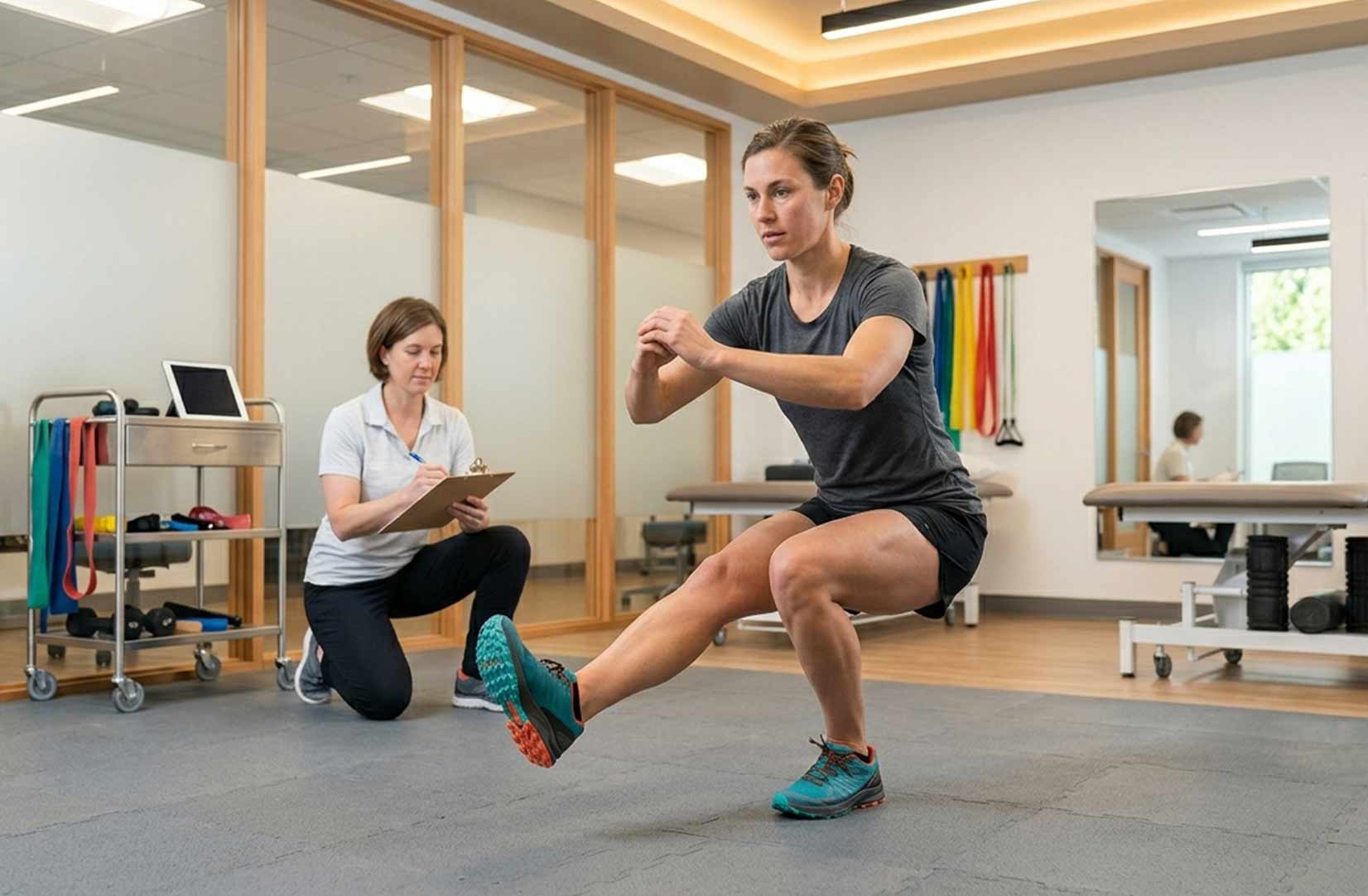
ACL Rehabilitation
Return To Sport Testing After ACL Surgery: Objective Assessment, Readiness Criteria and Safe Return to Competition
The Question Every ACL Patient Faces
At some point in every ACL rehabilitation journey, the same question arises. The swelling has settled. The running is progressing. The gym work is feeling increasingly normal. The knee, for the first time in months, is beginning to feel something close to trustworthy again.
Is it ready for sport?
It is one of the most important clinical questions in musculoskeletal rehabilitation — and historically, it has been answered in the least scientific way imaginable. For decades, the answer was determined almost entirely by time. Nine months. Twelve months. A surgeon’s preferred protocol. A date circled on a calendar. The implicit assumption was that time heals, and that healing means readiness.
Modern ACL rehabilitation has fundamentally challenged that assumption. Return to sport decisions made purely on the basis of time post-surgery, without objective physical and psychological assessment, carry a meaningful and largely avoidable risk. The evidence for this is now substantial — and the clinical implications are clear.
Being pain-free is not the same as being ready. Being months post-surgery is not the same as being ready. Objective testing exists to establish the difference.
Why Passing Time Is Not The Same As Being Ready
The biological process of graft maturation after ACL reconstruction continues for up to 24 months following surgery. During the period between approximately three and twelve months, the graft undergoes a process called ligamentisation — a remodelling phase during which it is mechanically weaker than it will eventually become. The timing of return to sport frequently coincides with this window of relative vulnerability.
Kyritsis et al. (2016), in a landmark study published in the British Journal of Sports Medicine, found that athletes who returned to sport without meeting a comprehensive battery of objective discharge criteria were more than four times as likely to sustain a graft rupture as those who met all criteria before returning. The study identified specific physical benchmarks — including quadriceps symmetry, hop testing performance, and single-leg functional capacity — as the meaningful predictors of safe return, not time from surgery.
Paterno et al. (2017), writing in the American Journal of Sports Medicine, found that young female athletes who returned to sport after ACL reconstruction were significantly more likely to sustain a second injury in the first two years of return than age-matched controls — a finding that underscores how comprehensively physical capacity must be restored before competitive exposure, not simply rehabilitated to a point of symptomatic comfort.
The purpose of return to sport testing is to move the decision from subjective to objective. From ‘the knee feels ready’ to ‘the knee can demonstrate readiness’. This distinction is not semantic. It is protective.
What Return To Sport Testing Involves
A comprehensive return to sport assessment does not rely on any single test or measure. It combines multiple physical assessments — each measuring a distinct aspect of function — with a structured evaluation of psychological readiness. Together, these measures provide a multi-dimensional picture of whether the knee is genuinely prepared for the demands of competition.
At Atherapy, return to sport assessment typically incorporates hop testing, lower limb strength assessment, movement quality evaluation, force plate analysis where available, sport-specific movement screening, and a validated psychological readiness measure. The results are considered collectively, not in isolation — because a patient who achieves adequate hop test scores but demonstrates poor psychological readiness, or who tests well on strength but shows significant landing asymmetry under fatigue, is not comprehensively ready for return to sport.
WHY A SINGLE TEST IS NEVER SUFFICIENT
No individual measure captures the full complexity of sport readiness. A patient may achieve a high limb symmetry index on isokinetic strength testing while still demonstrating significant landing strategy deficits under fatigue. Another may pass hop testing while showing clinically meaningful fear of reinjury that will alter their movement patterns under competitive pressure. Return to sport assessment is inherently multi-dimensional, and decisions should reflect the whole picture.
The Hop Testing Battery
Hop testing is one of the most widely used and well-validated components of ACL return to sport assessment. It evaluates the knee’s ability to produce, control, and tolerate force during dynamic single-leg tasks — providing a functional measure of limb symmetry that complements but does not replace strength testing.
Single-Leg Hop for Distance
What it measures: explosive propulsion and landing stability
The patient hops as far as possible on a single leg and must stick the landing. Distance is recorded and compared between limbs. This test primarily evaluates the knee’s ability to produce force explosively and absorb it on landing. A limb symmetry index below 90% between the operated and non-operated limb is generally considered clinically significant, though emerging evidence suggests that even higher thresholds may be appropriate for athletes returning to high-demand pivoting sports.
Triple Hop for Distance
What it measures: sustained force production across three sequential landings
Three consecutive hops on a single leg, with distance recorded from first takeoff to final landing. This test places greater cumulative demand on the quadriceps, posterior chain, and landing control systems than a single hop — making it more sensitive to residual deficits that may not be apparent during a single explosive effort.
Crossover Hop for Distance
What it measures: lateral stability and rotational control
Three hops across a line, alternating direction with each hop. This test introduces a rotational and lateral stability demand that the other hop tests do not replicate, making it particularly relevant for athletes returning to sports involving cutting and directional change. Asymmetry on the crossover hop when other tests show symmetry may indicate residual rotational stability deficits.
Timed Six-Metre Hop
What it measures: speed, rhythm, and consistency under repeated loading
The patient hops as fast as possible over six metres on a single leg. Time is recorded and compared between limbs. This test evaluates not simply peak force production but the ability to sustain rhythmic single-leg loading at speed — a quality that is highly relevant to running mechanics, acceleration, and sport-specific movement.
Collectively, these four tests form what is commonly referred to as the hop testing battery. Normalising performance across all four, rather than passing one or two, is considered the more clinically rigorous approach. Losciale et al. (2022), in a large-scale systematic review in the British Journal of Sports Medicine, found that athletes who passed a comprehensive multi-test battery were significantly more protected against second injury than those assessed on a single measure alone.
Strength Assessment and Limb Symmetry
Lower limb strength assessment is one of the most clinically important components of return to sport testing — and the one with the strongest evidence base connecting it directly to reinjury risk.
Quadriceps strength is the primary focus, typically assessed using isokinetic dynamometry where available, or through validated functional measures such as single-leg press, single-leg extension, or force plate-based testing where dynamometry is not accessible. The result is expressed as a limb symmetry index — the percentage of strength in the operated limb relative to the non-operated limb.
The 90% limb symmetry index threshold has become a widely adopted benchmark in ACL rehabilitation, supported by the work of Grindem et al. (2016) in the Delaware-Oslo cohort. However, more recent evidence has prompted a reassessment of whether 90% is a sufficiently high bar for athletes returning to high-demand pivoting sports. Kotsifaki et al. (2022), writing in the British Journal of Sports Medicine, found that many athletes returning to sport at 90% limb symmetry still demonstrated meaningful performance deficits compared to healthy controls — suggesting that for athletes with demanding sport profiles, pursuing a higher threshold of 95% or beyond may be clinically appropriate.
Hamstring strength is also assessed, both in absolute terms and as a ratio relative to quadriceps strength. Hamstring weakness following ACL reconstruction is common and clinically significant — the hamstrings provide important dynamic stability to the knee under load, and inadequate hamstring function elevates stress on the graft during high-speed and deceleration tasks.
Force Plate Assessment
Force plate technology provides objective, quantitative data on how the body produces, distributes, and absorbs force during dynamic movement tasks — data that is not visible to the naked eye and cannot be captured through clinical observation alone.
During ACL return to sport assessment, force plate testing typically evaluates single-leg and double-leg landing mechanics, vertical jump and landing force production, braking and deceleration force profiles, and limb symmetry during high-demand impact tasks. This provides direct measurement of the qualities that sport demands most acutely — and that are most compromised in the period following ACL reconstruction.
Force plate data is particularly valuable because it can identify compensatory loading strategies that appear normal during slower, lower-demand tasks but become apparent under higher-speed, higher-force conditions. A patient who demonstrates acceptable movement quality during a walking assessment or a slow single-leg squat may show significant loading asymmetry during a landing task at sport-relevant speed — a discrepancy that force plate testing captures precisely.
Psychological Readiness: The Overlooked Dimension
Physical testing captures what the knee can do. Psychological readiness assessment captures whether the athlete will actually do it — with full commitment, without protective movement strategies, and under the pressure of competitive environments.
Fear of reinjury following ACL reconstruction is one of the most consistently documented barriers to successful return to sport. Athletes who are physically capable of returning but psychologically unready frequently demonstrate protective running mechanics, avoidance of high-demand movements, hesitation during directional changes, and a reduced willingness to expose the knee to the controlled collisions and reactive demands that sport involves. These adaptations are protective responses to perceived threat — but under competitive conditions, they are often the adaptations that create the greatest biomechanical risk.
The ACL Return to Sport after Injury scale — the ACL-RSI — is the most widely validated psychological readiness tool in ACL rehabilitation. Developed and validated by Webster and Feller, and evaluated in multiple large-scale studies, the ACL-RSI measures emotions related to returning to sport, confidence in sport performance, and risk appraisal. Webster et al. (2018), in a prospective study published in the American Journal of Sports Medicine, found that athletes with low ACL-RSI scores at the time of return to sport clearance were significantly more likely to fail to return to their pre-injury level of activity — and did so despite having achieved physical readiness benchmarks. Psychological readiness, the study concluded, is an independent predictor of return to sport outcome, not simply a soft consideration.
More recently, Sonesson et al. (2021) confirmed in the American Journal of Sports Medicine that psychological readiness at return to sport was the strongest independent predictor of long-term functional outcome at two years post-surgery — outperforming physical test performance as a predictor when both were entered into the same statistical model.
Physical testing captures what the knee can do. Psychological readiness assessment captures whether the athlete will actually do it — fully, confidently, and without protective movement strategies.
What The Results Actually Mean
Return to sport test results are not simply pass or fail. They are clinical information — and interpreting them well requires understanding what each measure tells you, what it does not tell you, and how the pattern of results across all measures together informs the decision.
A patient who achieves 95% quadriceps limb symmetry, passes all four hop tests above 90%, demonstrates symmetrical landing mechanics on force plate assessment, and scores well on the ACL-RSI represents a genuinely comprehensive picture of readiness. A patient who achieves similar hop test scores but has a 78% quadriceps limb symmetry index has achieved one component of readiness while a more important predictor of safety remains significantly below target. Results should always be considered in context, in combination, and in relation to the specific demands of the sport and position the athlete is returning to.
At Atherapy, results are discussed in full with the patient following assessment. Where targets have not been met, the specific rehabilitation priorities that remain are identified clearly, and a structured plan to address them is built before reassessment. No result, however disappointing in the moment, is without clinical value — because each test that falls short of target identifies a specific area where further rehabilitation input will reduce risk and improve long-term outcomes.
When Testing Indicates You Are Not Yet Ready
It is important to be direct about this: failing to meet return to sport criteria at a given point is not a setback in the catastrophic sense that many patients fear. It is clinical information that identifies where rehabilitation effort should be directed before competition exposure is appropriate.
The most common findings that indicate further rehabilitation is needed before return to sport include quadriceps limb symmetry below 90%, significant inter-limb asymmetry on hop testing, landing strategy deficits identified on force plate assessment, inadequate hamstring strength relative to quadriceps, and low psychological readiness scores on the ACL-RSI.
TESTING DOES NOT MEAN THE REHABILITATION PROCESS HAS FAILED
A patient who does not meet all return to sport criteria at nine months is not behind. They are in exactly the position that objective testing is designed to identify — with a clear roadmap for the specific rehabilitation that will make their return to sport safer, more confident, and more sustainable. The alternative — returning without testing — provides no such roadmap, and carries the full weight of an uninformed decision.
Return To Training vs Return To Competition
One of the most clinically important distinctions in late-stage ACL rehabilitation is the difference between returning to training and returning to competition. These are not the same thing — and treating them as equivalent is one of the most common errors in the management of the return to sport phase.
Training environments allow control over intensity, duration, contact, and complexity. Athletes can be gradually re-exposed to the demands of their sport in a managed progression that continues to build capacity while reducing risk. Competition environments remove that control entirely. Decision-making speed, contact, reactive movements, fatigue, and the emotional arousal of competitive play all combine to create loading profiles that training does not fully replicate.
Return to training should typically precede return to competition by several weeks, with the intervening period used to re-expose the athlete to full training demands, monitor response, and build the sport-specific conditioning and psychological readiness that competition requires. For contact sports, a graduated return through non-contact training, partial contact, and full training before competition participation is a structured approach that reduces risk at each transition.
Sport-Specific Considerations
Return to sport criteria and the emphasis within testing should reflect the specific demands of the sport and position the athlete is returning to. A recreational runner returning to parkrun places fundamentally different demands on the knee than a Premier League winger returning to full competitive training. Testing should be contextualised accordingly.
For athletes returning to pivoting and cutting sports — football, rugby, basketball, netball, tennis, skiing — rotational stability, reactive deceleration, and multi-directional confidence are particularly important assessment domains. The crossover hop test and force plate landing assessments are especially relevant for these populations, as they capture the rotational and lateral demands that straight-line testing does not.
For distance runners, cumulative loading tolerance, running economy, and fatigue-related changes in mechanics are the primary concerns. For gym-based athletes returning to weightlifting or CrossFit, force production under high load and bilateral symmetry during compound movements are the most relevant targets. At Atherapy, return to sport assessment is always tailored to the individual’s specific sport and performance level, not applied as a generic protocol.
Speak To A Clinician About Your ACL Prehabilitation Programme
If you have recently sustained an ACL injury, are awaiting surgical opinion, or want expert guidance on preparing for reconstruction, our clinical team will design a structured programme tailored to your injury, sport, surgical pathway, and long-term performance goals.
Book at your nearest clinic: Moorgate | Strand | Chiswick
Evidence & Research References
This page reflects current evidence-based practice in ACL return to sport assessment. Key research informing the content includes:
- Kyritsis P et al. (2016). Likelihood of ACL graft rupture: not meeting six clinical discharge criteria before return to sport is associated with a four times greater risk of rupture. British Journal of Sports Medicine.
- Grindem H et al. (2016). Simple decision rules can reduce reinjury risk by 84% after ACL reconstruction: the Delaware-Oslo ACL cohort study. British Journal of Sports Medicine.
- Paterno MV et al. (2017). Self-reported fear predicts functional performance and second ACL injury after ACL reconstruction and return to sport. Journal of Orthopaedic & Sports Physical Therapy.
- Dingenen B, Gokeler A (2017). Optimization of the return-to-sport paradigm after anterior cruciate ligament reconstruction. Sports Medicine.
- Webster KE et al. (2018). Psychological readiness to return to sport is associated with second ACL injuries. American Journal of Sports Medicine.
- Kotsifaki A et al. (2022). Single leg vertical jump performance identifies knee function deficits at return to sport after ACL reconstruction in male athletes. British Journal of Sports Medicine.
- Losciale JM et al. (2022). The association between passing return-to-sport criteria and second ACL injury risk: a systematic review with meta-analysis. British Journal of Sports Medicine.
- Sonesson S et al. (2021). Psychological readiness to return to sport is associated with outcome two years after ACL reconstruction. American Journal of Sports Medicine.
- Melbourne ACL Rehabilitation Guide — contemporary evidence-based rehabilitation and return to sport principles.
- Aspetar Return-to-Sport Guidelines — criterion-based return-to-performance frameworks.
Our rehabilitation approach is further informed by the clinical work of Enda King, Mick Hughes, Claire Robertson, Phil Glasgow, Adam Culvenor, Tim Gabbett, Seth O’Neill, and Ebonie Rio. All decisions should remain individualised — frameworks inform clinical reasoning, they do not replace it.
London Physiotherapy Team
Welcome to the Atherapy expert clinical team. We are a dedicated group of qualified physiotherapists and sports medicine specialists committed to delivering innovative, evidence-based rehabilitation. Our practice is built on a holistic approach to physical health, firmly believing that injury prevention is just as vital as the cure. From treating acute sports injuries to designing custom performance optimization programs, our clinicians work collaboratively to help you safely reach your goals.
Meet our resident experts below and find the right specialist for your recovery journey.

- With 25+ years of Premier League and Championship experience, Andrew has led Medical, Science, and Performance departments for Hull City, Nottingham Forest, Derby County, and Preston North End, following earlier work at the Manchester United Academy
- Specialist in lower limb rehabilitation
- Post-operative rehabilitation
- Back pain and complex spinal presentations
- Elite athlete management including manual therapy, gym rehabilitation and acupuncture
- Specialises in complex cases and second opinion rehabilitation planning including return to play
- Limited clinical availability due to wider clinical leadership and operational responsibilities
Andrew Balderston
Based at Moorgate
- Specialist in exercise-based rehabilitation, manual therapy and injury prevention
- Experienced in post-operative rehabilitation and progressive return to activity
- Clinical interests include sports injuries, cervical spine and low back dysfunction, shoulder, knee, foot and ankle rehabilitation
- Combines hands-on treatment with targeted strength and rehabilitation programming
- Focused on structured rehabilitation to help patients rebuild strength, movement confidence and function
- Specialist interest in women’s health support including manual lymphatic drainage during pregnancy and pre/post-natal care
- Over 15 years of clinical experience across private practice, sports rehabilitation and women’s health settings
- Fluent in English, Portuguese and Italian
Fernanda Saldanha
Based at Chiswick
- Extensive experience working within elite professional football and private practice
- Former Tottenham Hotspur Academy physiotherapist specialising in performance rehabilitation and return-to-play management
- Specialist interest in post-operative rehabilitation and upper and lower limb injury management
- Experienced in managing complex and recurrent injuries through structured, evidence-based rehabilitation planning
- Clinical approach combines manual therapy, gym-based rehabilitation, movement analysis and acupuncture
- Focused on restoring movement quality, strength under load and long-term performance outcomes
- Fluent in English and Greek
Dimitrios Michtatidis
Based at Chiswick and Strand

- Level 4 Strength & Conditioning Coach
- Medical Acupuncture & Dry Needling Qualified
- Combines detailed clinical assessment with progressive rehabilitation and strength & conditioning principles
- Specialist interest in gym-based rehabilitation and return-to-sport management
- Clinical interests include acute sporting injuries, post-operative orthopaedic rehabilitation (including ligament reconstructions, meniscal and labral repairs) and hip/groin pain in active populations
- Experience managing both active general population and performance-focused clients
- Adjunct treatment techniques include dry needling and shockwave therapy
Claire Cuffe
Based at Moorgate and Strand

- Over 5 years experience treating orthopaedic injuries, chronic pain and post operative care
- Advanced certifications in dry needling for hands, face, feet, lower limb, upper limb and lumbopelvic region
- Certified pelvic floor physio for both men and women with an interest in treating clients pre and post natal
- Special interest in strength and conditioning programming for clients training for half/full marathons