

Understanding the evidence. Getting the right treatment.
Tracking your progress.
From your first acute flare to full return to activity, the complete Atherapy sciatica resource
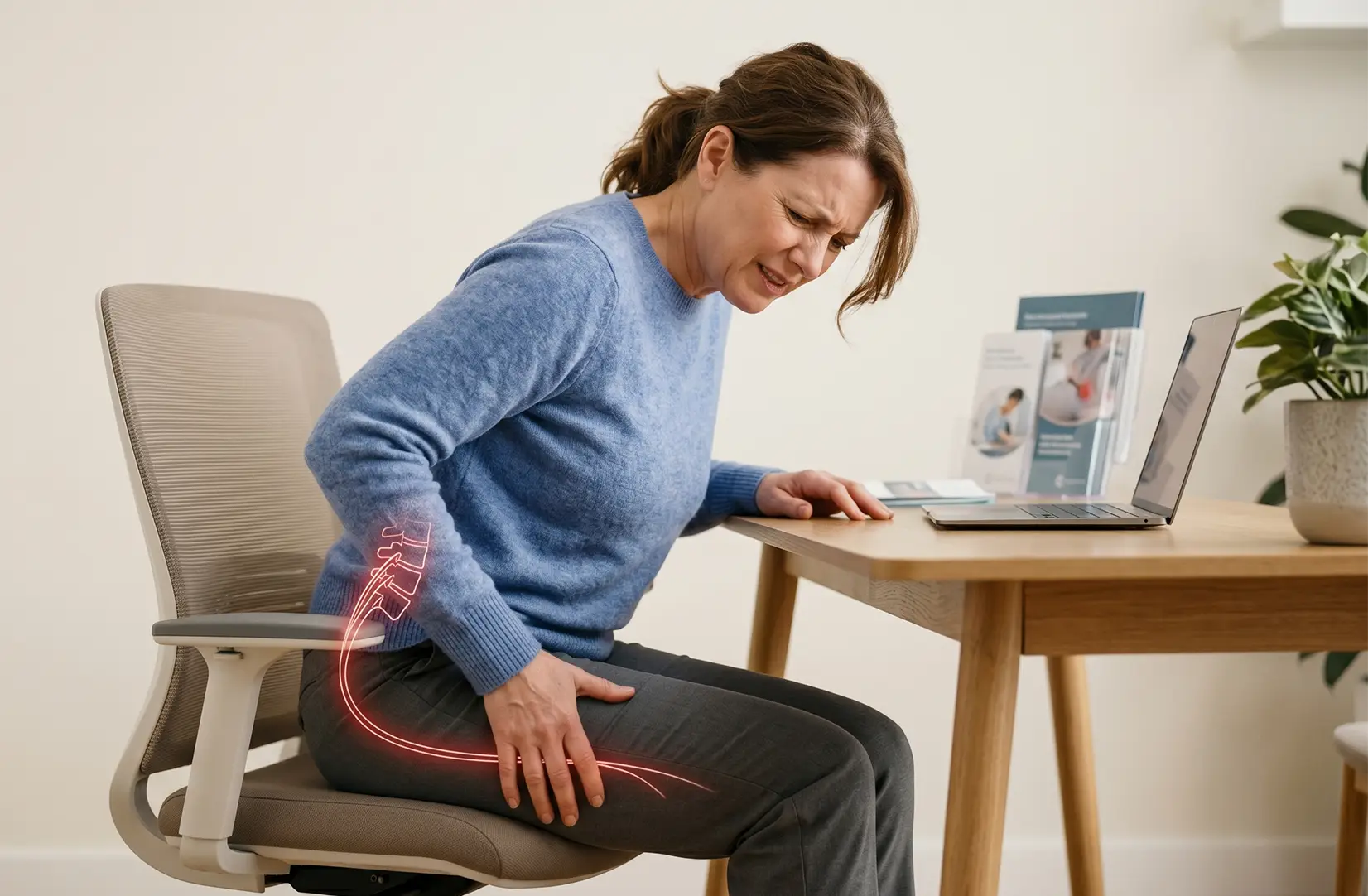
Many people arrive worried they have permanently damaged their spine. Others fear they will need surgery. Most are surprised, and relieved, to learn how often sciatica resolves with the right approach. For many patients, understanding what is happening reduces fear almost immediately.
If you have sciatica, you will know it. The pain does not stay in your back: it travels. Down through your buttock, into your thigh, sometimes all the way to your foot. It can burn, shoot, ache, or go numb. It can wake you at night.
Usually, something manageable is happening: a disc in your lower spine is pressing on a nerve. That sounds alarming, but the evidence is genuinely reassuring: disc herniations reduce in size on their own in the majority of cases, and most people recover significantly with the right treatment.
What Is Sciatica?
A plain-language explanation of the sciatic nerve, why it becomes irritated, what symptoms it produces, and what it means for your recovery.
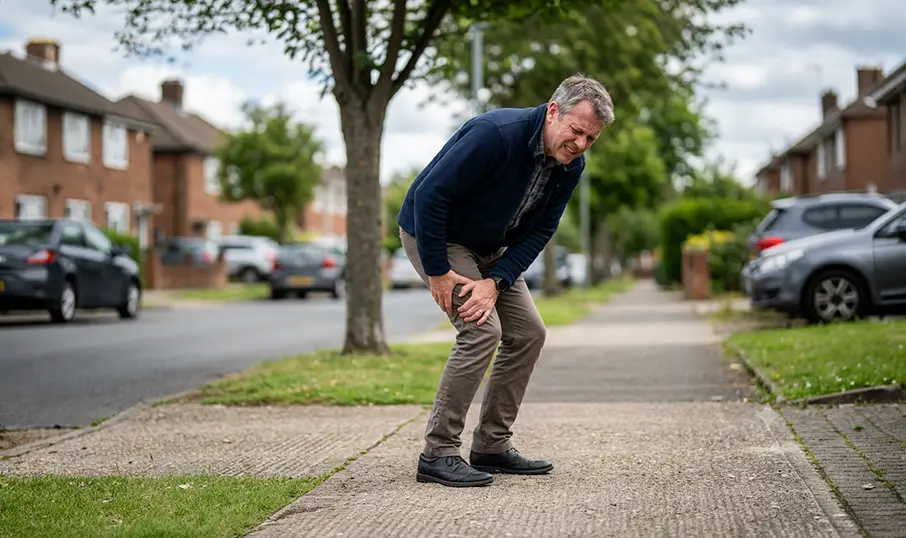
What Causes Sciatica?
Nerve-related leg pain gets labelled sciatica, rarely explained. Several different sources produce near-identical symptoms, and each responds to a completely different treatment approach.
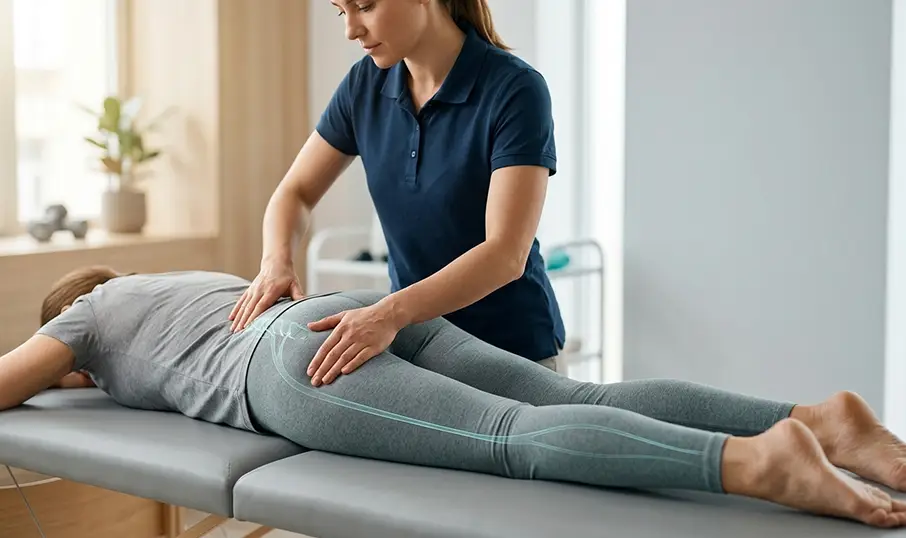
Sciatica Red Flags
Most sciatica responds well to physiotherapy. Some symptoms require emergency medical assessment. This page tells you which ones.

Sciatica Assessment
Sciatica is irritation of the sciatic nerve. Having a label is not the same as understanding it, and understanding is what shapes your recovery.
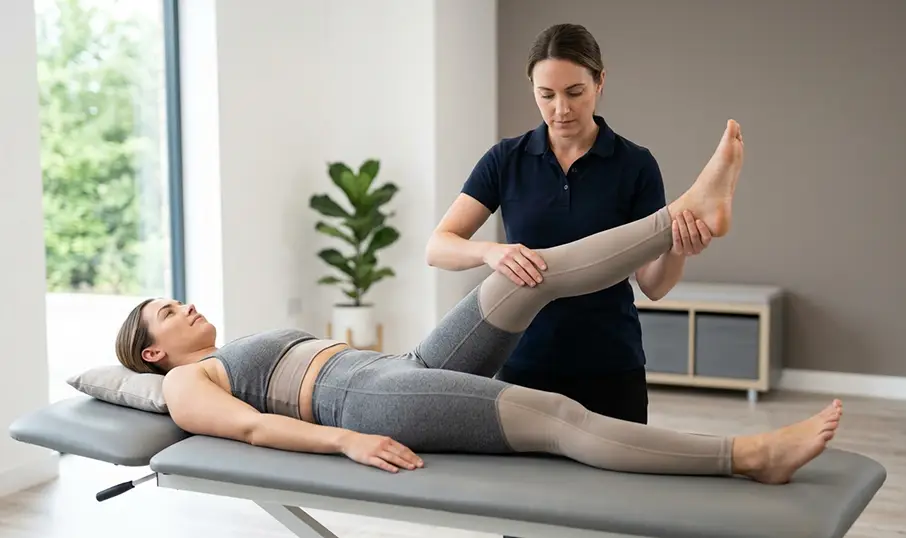
Treatment for Sciatica
Sciatica improves for most people with the right approach. Physiotherapy explains what's happening, guides safe movement, and identifies the few needing imaging or referral.

Exercises for Sciatica
There is no standard set of sciatica exercises. We assess what is driving your pain, then build a structured programme that restores normal movement.
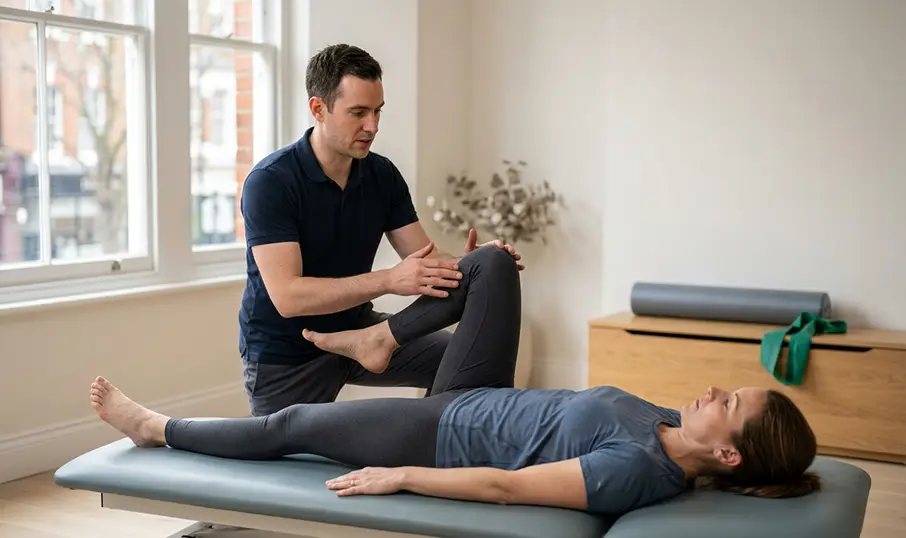
Sciatica During Pregnancy
Pregnancy sciatica is common and treatable. Specialist physiotherapy is safe throughout, will not harm your baby, and most symptoms settle after birth.

Sciatica Not Improving
If sciatica is not improving, it rarely means nothing can be done. It usually means the presentation needs reassessing and the approach revising.
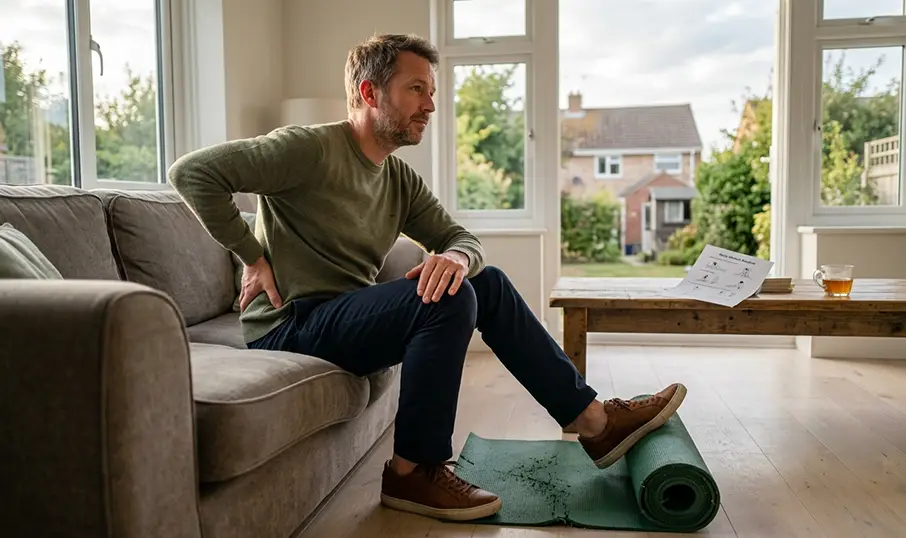
Physiotherapy After Disc Surgery
Pain after disc surgery is normal and does not mean the operation failed. Structured rehabilitation gets you back to full activity safely

⚠️ URGENT, When to Go to A&E
If you have any changes to your bladder or bowel, numbness in the saddle area (inner thighs or groin), or rapidly worsening weakness in both legs: go to A&E immediately or call 999. Do not wait for a physiotherapy or GP appointment.
Written by
Andrew Balderston
MSc, HCPC, MCSP, AACP
ChiefOperating Officer & Clinical Director, Atherapy
- Clinical Director and COO, Atherapy
- FIFA Diploma in Football Medicine
- Hull City FC - Head of Medical Services 2018–2025
- Nottingham Forest FC - 2009–2018
About the author
Chartered Physiotherapist with over 20 years’ experience in elite professional football, including senior roles at Hull City, Nottingham Forest, and Manchester United Academy. Holds an MSc inPhysiotherapy, FIFA Diploma in Football Medicine, and has led integrated Medical, Sports Science and Performance departments at Premier League and Championship level. Now Clinical Director at Atherapy, where he oversees high-performance rehabilitation pathways drawing directly on elite sport methodology.

At a Glance
Most people with sciatica improve without surgery. At an initial assessment, Atherapy clinicians focus on:
- Identifying which nerve root is affected and how severely
- Ruling out any symptoms that need urgent medical attention
- Determining your directional preference, the movement pattern that settles the nerve
- Building a movement-based recovery programme around that finding
- Tracking progress objectively at every appointment
Quick Answer
Key findings, each referenced in full below.
- Sciatica is nerve pain, not back pain. It travels from the lumbar spine down the leg via the sciatic nerve, typically caused by a disc pressing on a nerve root.
- Most herniations resolve without surgery. 90% show measurable reduction in size over time (Chiu et al., AJNR, 2015).
- Bed rest slows recovery. Graded activity consistently produces better outcomes than rest (Hagen et al., Cochrane, 2010).
- Direction-specific physiotherapy outperforms generic exercise. Treatment built around how your nerve responds at assessment produces significantly better outcomes (Browder et al., JOSPT, 2007).
- Surgery and conservative management reach equivalent outcomes at one to two years. Early surgery offers faster short-term relief but equal long-term results (Peul et al., NEJM, 2007).
What Is Sciatica?
Sciatica is pain that travels along the sciatic nerve (the largest nerve in the body, running from the lower spine through the buttock and down each leg to the foot. The term describes a symptom, not a diagnosis: it tells you where the pain is going, not what is causing it.
In the majority of cases, the cause is a lumbar disc herniation. The discs between the vertebrae act as cushions. When the outer layer weakens, the inner material can press outward; if it presses on a nerve root, the result is pain that travels down that nerve's path into the leg.
The character of the pain is typically different from back pain. It may burn, shoot, or feel like an electric shock. It may be accompanied by numbness, tingling, or weakness in the leg or foot. Other causes include spinal stenosis, spondylolisthesis, and (less commonly) piriformis syndrome, where a gluteal muscle irritates the nerve directly.
→ Detailed anatomy and mechanism: What Is Sciatica?
→ Causes and risk factors: What Causes Sciatica?
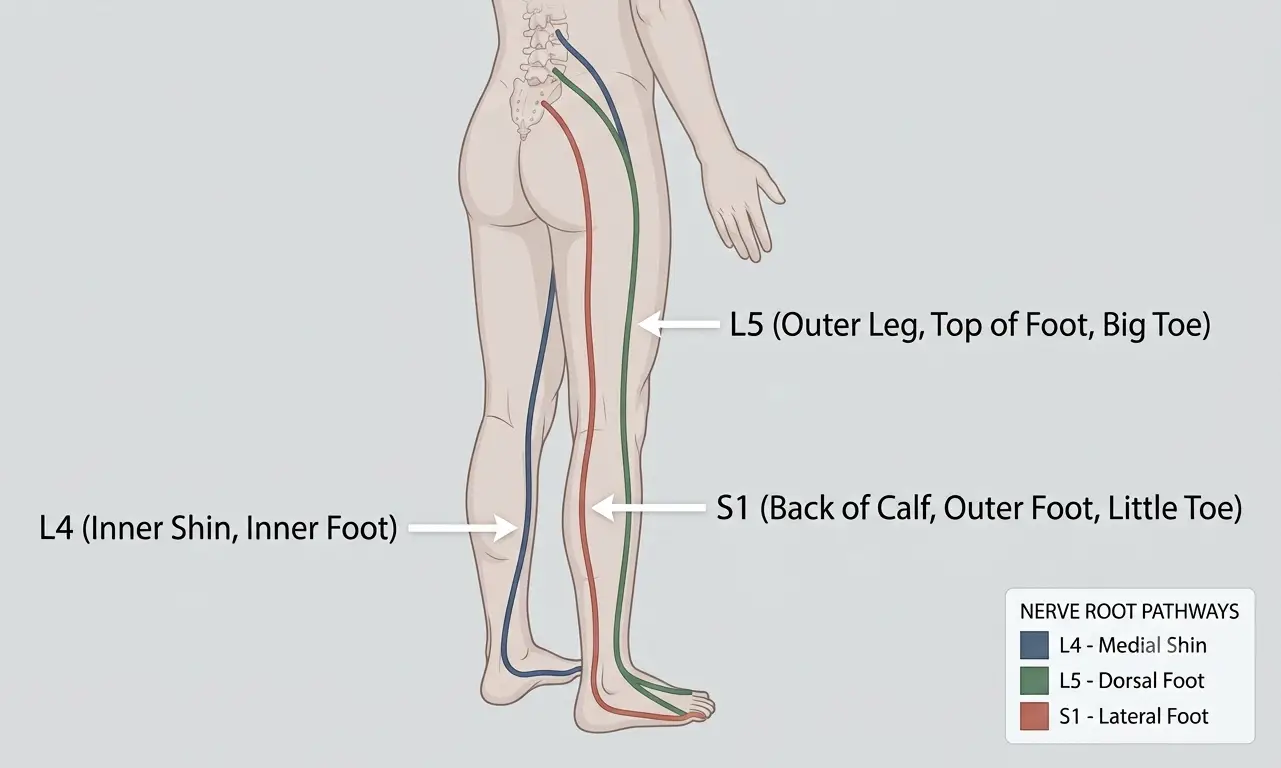
Leg pain distribution map
What the Evidence Says
The research on sciatica is more reassuring than most patients expect. Five findings in particular shape how Atherapy's senior physiotherapy team approaches every case.
Disc herniations reduce in size on their own
Chiu CC et al., American Journal of Neuroradiology, 2015. This systematic review found that 90% of lumbar disc herniations showed measurable reduction in size without surgical intervention. The largest herniations showed the greatest tendency to reduce. This is the evidence base for honest reassurance at initial assessment: the disc pressing on the nerve commonly reduces in size over time.
What the clinician says
The question I am most often asked is: 'Will this get better?' The honest answer, and the evidence-based answer, is yes, in most cases. What varies is how quickly, and how completely, depending on how it is managed.
Andrew Balderston MSc, HCPC, MCSP, AACP
Direction-specific treatment outperforms generic exercise
Browder DA et al., Journal of Orthopaedic and Sports Physical Therapy, 2007. This randomised controlled trial compared direction-specific exercise with generalised strengthening in patients with lumbar radiculopathy (nerve pain radiating down the leg). The direction-specific group showed significantly greater improvement. Treatment at Atherapy is built around this principle: the programme follows the nerve, not a standard protocol.
Surgical and conservative outcomes converge at one to two years
Peul WC et al., New England Journal of Medicine, 2007. This landmark trial compared early disc surgery with conservative management in patients with severe sciatica. Outcomes were equivalent at one year. Early surgery produced faster short-term relief, but the difference resolved. For most patients, surgery is an option, not an inevitability, and the decision should be made on clinical grounds rather than anxiety.
Bed rest is not beneficial
Hagen KB et al., Cochrane Database of Systematic Reviews, 2010. Bed rest is no more effective than staying active, and may produce worse outcomes. The instinct to rest when in pain is understandable. The evidence does not support it.
NICE recommends physiotherapy as first-line treatment
NICE Guideline NG59, 2016 (updated 2020). Exercise and physiotherapy are recommended as first-line management for sciatica. Routine early imaging is not recommended. Scanning is appropriate where findings would change management, typically when surgical opinion is being considered or red flag features are present.
What Often Makes Sciatica Worse
Several common responses to sciatica, most of them instinctive, consistently slow recovery or worsen symptoms. Understanding them is part of clinical management.
Sustained sitting increases intradiscal pressure. Most patients find leg pain worsens after 20–30 minutes seated. Frequent short walks and position changes help significantly.
Repeatedly checking 'how bad is it today', bending forward, pressing on sore areas, keeps the nervous system activated. It prevents the natural downregulation that supports recovery.
Avoiding movement weakens spinal support structures and can sensitise the nervous system. It can also create fear-avoidance (a pattern where movement becomes feared independently of the original injury, sustaining pain beyond the disc itself).
A good day is not a signal to catch up on everything avoided. This pattern reliably produces a significant flare the following day. Recovery is not linear.
Forward bending and hamstring stretches are among the most common self-treatments, and among the most likely to aggravate in the acute phase. Whether stretching helps or harms depends on the individual clinical picture.
Exercise prescribed without knowing how the nerve is behaving can worsen symptoms. This is the most common reason self-directed physiotherapy from the internet fails to help, and sometimes makes things worse.
What Recovery Usually Feels Like
Recovery from sciatica has a characteristic pattern. Knowing what to expect can significantly reduce the anxiety that often accompanies it.
- Burning becomes aching. The sharp, shooting quality of acute nerve pain typically softens to a duller ache as the nerve settles. This is a positive sign.
- Pain centralises. Leg pain moving upward (from the foot or calf toward the buttock), is called centralisation. It is the most reliable indicator of a good response to treatment.
- Good days and bad days are normal. Recovery is rarely linear. Increased symptoms following activity do not indicate a setback: they are a normal feature of nerve recovery.
- Tingling may outlast pain. Neurological symptoms, numbness, tingling in the foot, can persist for weeks after pain has resolved. Nerve tissue recovers more slowly than soft tissue. This is not a sign of ongoing damage in most cases.
- Morning stiffness is common. Discomfort on waking is typical in disc-related sciatica. It usually eases within 20–30 minutes of movement.
What the clinician says
The single most reassuring sign in clinic is centralisation: when a patient says the pain has moved from the foot to the buttock. That shift tells me the nerve is settling and the approach is working. Most patients don't know to look for it. I explain it at the first appointment.
Andrew Balderston MSc, HCPC, MCSP, AACP
How Long Does Sciatica Last?
The timeline below is evidence-informed and realistic, not aspirational. Individual recovery varies with the severity of symptoms, the presence of neurological findings, and how promptly a focused treatment approach is established.
The Atherapy Approach
Atherapy's approach to sciatica is shaped by 20 years of clinical practice in elite football, Nottingham Forest and Hull City FC, applied to every patient, regardless of their level of activity. The same criteria-based framework used at Premier League level informs how a first appointment with an office worker in acute pain is structured.
The distinction is not a technique or a piece of equipment. It is the rigour of the assessment, the precision of the treatment decision, and the objectivity of how progress is tracked.
What Recovery Can Look Like
The narrative below is anonymised clinical experience, not a testimonial or a guarantee. It illustrates a typical presentation and the clinical process that follows.
A typical patient presentation - based on anonymised clinical experience
Office worker, 35, with 8-week left-sided sciatica
A 35-year-old in financial services presented with eight weeks of progressive left-sided leg pain. He had rested completely for two weeks on a colleague's advice, with no improvement. Assessment identified an L5 nerve root pattern with a clear directional preference: extension reduced leg pain; flexion increased it. PSFS: 3/10. A direction-specific programme was prescribed alongside postural guidance. Leg pain resolved over eight sessions. Residual foot tingling cleared four weeks later. Return to running at week ten. PSFS at discharge: 8/10. No surgical intervention.
Assessment and Referral
Every sciatica patient begins with a full clinical assessment, not a triage appointment. The aim is a complete clinical picture and an honest conversation about prognosis and the most appropriate pathway.
What the assessment covers
- A detailed history: symptom onset, behaviour, what aggravates and what relieves, and what has already been tried.
- Full neurological examination, dermatomal sensation, myotomal strength, and deep tendon reflexes, to establish a baseline and identify any deficit requiring medical referral.
- Assessment of lumbar movement and directional preference: how the spine and nerve respond to specific movements. This is the finding that shapes the treatment programme.
- Screening for red flag features and cauda equina symptoms.
- PSFS and NPRS administered at baseline, then repeated at four weeks and discharge, objective tracking, not clinical impression.
When physiotherapy is the right pathway
Most patients with acute or subacute sciatica respond well to structured physiotherapy. NICE NG59 supports conservative management as first-line treatment, and the evidence favours a movement-based approach over rest or generic exercise.When onward referral is appropriate
When onward referral is appropriate
Not every sciatica presentation is a physiotherapy case. Onward referral is recommended where:
- Red flag features are present, cauda equina symptoms require immediate A&E, not a physiotherapy appointment.
- Progressive neurological deficit is identified: worsening weakness or increasing neurological change not responding to conservative management. Surgical decompression is indicated where deficit is progressive (Jacobs et al., European Spine Journal, 2011).
- Symptoms have not responded adequately, following a complete course of physiotherapy, typically eight to twelve weeks.
- Surgical opinion is being considered, Atherapy has established referral pathways to Fortius, BUPA, HCA, and Schoen Clinic, and can coordinate this directly.
When surgery is considered
Surgery is not the default outcome for sciatica, but it is the right pathway for some patients. Atherapy clinicians will raise it when:
- Progressive neurological deficit. Worsening foot drop or leg weakness that is not responding to conservative management. Surgical decompression may be indicated on clinical grounds independent of pain levels.
- Cauda equina symptoms. Changes to bladder or bowel, saddle numbness, or bilateral leg weakness require immediate A&E: surgical decompression is a medical emergency in this context.
- No meaningful improvement after structured physiotherapy. Typically defined as insufficient progress after eight to twelve weeks of a well-executed, direction-specific programme.
- Severe, persistent radicular pain. Where quality of life is significantly impaired and conservative management has been fully explored, surgical consultation is a reasonable next step.
For patients considering or recovering fromsurgery: /sciatica/after-disc-surgery/ (SC09)
When to seek urgent help
Go to A&E immediately or call 999 if you have:
- Changes to your bladder or bowel
- Numbness in the saddle area (inner thighs or groin)
- Rapidly worsening weakness in both legs
If you are unsure, call NHS 111. If symptoms are severe or rapidly worsening, call 999 or go to A&E.
Full guidance: /sciatica/red-flags/
When should I go to A&E?
Go to A&E immediately — or call 999 — if you have:
- Difficulty passing urine or unexpected bladder leakage
- Loss of bowel control or inability to sense when you need the toilet
- Numbness in the saddle area (inner thighs, perineum, genitals)
- Rapidly worsening weakness in both legs
Call NHS 111 if uncertain. Do not wait overnight.
Is surgery inevitable with sciatica?
No — for the large majority, it is not. Peul et al. (NEJM, 2007) found that surgery and conservative management produce equivalent outcomes at one year: early surgery relieves pain faster, but the difference resolves. Surgery becomes the appropriate pathway for progressive neurological deficit not responding to treatment, cauda equina symptoms (a surgical emergency), or insufficient progress after eight to twelve weeks of well-executed physiotherapy. Most patients do not reach that point.
Evidence Standards
Clinical references cited on this page
- Chiu CC, Chuang TY, Chang KH, Wu CH, Lin PW, Hsu WY. The probability of spontaneous regression of lumbar herniated disc: a systematic review. Clinical Rehabilitation. 2015;29(2):184–195. DOI: 10.1177/0269215514540919
- Peul WC, van Houwelingen HC, van den Hout WB, et al. Surgery versus prolonged conservative treatment for sciatica. New England Journal of Medicine. 2007;356(22):2245–2256. DOI: 10.1056/NEJMoa064039
- National Institute for Health and Care Excellence. Low back pain and sciatica in over 16s: assessment and management. NICE Guideline NG59. 2016 [updated 2020]. Available at: www.nice.org.uk/guidance/ng59
- Hagen KB, Jamtvedt G, Hilde G, Winnem MF. Bed rest for low back pain and sciatica. Cochrane Database of Systematic Reviews. 2010. DOI: 10.1002/14651858.CD001254
- Browder DA, Childs JD, Cleland JA, Fritz JM. Effectiveness of an extension-oriented treatment approach in a subgroup of subjects with low back pain: a randomized clinical trial. Physical Therapy. 2007;87(12):1608–1618. DOI: 10.2522/ptj.20060297
- Vlaeyen JWS, Linton SJ. Fear-avoidance and its consequences in chronic musculoskeletal pain: a state of the art. Pain. 2000;85(3):317–332. DOI: 10.1016/S0304-3959(99)00242-0
- Jacobs WC, van Tulder M, Arts M, et al. Surgery versus conservative management of sciatica due to a lumbar herniated disc: a systematic review. European Spine Journal. 2011;20(4):513–522. DOI: 10.1007/s00586-010-1603-7
Content reviewed annually. Next review: January 2027. This page provides general clinical information and does not constitute individual medical advice. If you are concerned about your symptoms, contact your GP or call NHS 111.
Ready to Take the Next Step?
A sciatica assessment begins with a complete clinical picture: neurological examination, movement assessment, and an honest conversation about what the evidence says about your specific presentation and your options.
Most people with sciatica improve significantly. Understanding what is happening with your nerve, and having a clear plan built around that finding, is usually the turning point.
Testimonial
What Our Clients Say
Trusted by those who demand the highest standards. Discover how we’ve elevated the lives of our clients.



If I could give 10 stars to Denzil I would
"Not only he is a great physiotherapist in terms of exercises and plans, but his humanity and deep understanding of the psychological burden carried by people with chronic pain is unparalleled. I have never come across anyone with such empathy and patience to make me overcome my fears, and I have been dealing with pain for 15 years and saw any possible doctor out there in multiple countries. He helped me immensely during a period of great pain and stress and I would not be where I am now if it wasn't for his help and support."





Results Beyond My Expectations!
"I contacted Atherapy with a long term shoulder problem, which had become much worse with recent Injury. They wasted no time assessing the issue, sending me for a scan and then recommending a superb surgeon. The estimated recovery timeline was reduced with the energetic and committed approach from James. I would highly recommend Atherapy, I would certainly return for future support.!"

Transformed My Life Completely!
"I’ve been going to Atherapy for the past 6 months now for both an AC joint shoulder and Achilles tendon injury. I honestly could not recommend a better physio. We sat down day 1 and set out my goals and put a plan in place and got back to full fitness ahead of schedule. I’ve seen multiple physios over the past 3 years for chronic shoulder pain and he was the only person to fully address the source of the problem rather than just alleviate the pain. 10/10."

Using Game Ready in the first few weeks after my ACL reconstruction made a noticeable difference in managing swelling and keeping the knee comfortable
“It helped me stay consistent with my early rehab exercises, particularly in that first month when the knee is most reactive. It became part of my daily routine alongside physio, rather than a standalone treatment.”

Excellent experience! I had really bad back pains.
"The pains were so bad that I could not sleep well and live well in general. However, the treatments I received at Atherapy and the exercises were super helpful. Now after just 2 months of treatments I am happy without bad back pains. Thank you!"
My quality of life today is 10x what it was
"Over 10 years and three ankle surgeries, I struggled with worsening pain—from my ankle up through my hips, shoulders, and neck—plus digestive issues that stumped doctors and PTs. Nothing worked until I met Dave. His deep expertise and relentless work ethic stood out immediately. He pinpointed weaknesses, built a tailored program, and adapted it as I improved. What truly set him apart was his unwavering belief in the process, which kept me going through setbacks. My quality of life is now 10x better. Thank you, Dave—I’m incredibly grateful."

After I injured my knee, I saw different physiotherapists with no luck… until I went to Atherapy
"They were fantastic! They found out what my issue was and provided me with some excellent exercises. After just two sessions, I felt a huge difference! I can highly recommend them as they gave me lots of support. You will be in good hands and Atherapy will help you get back on track!"