

Sciatica Red Flags,
When To Go To A&E
These symptoms are uncommon, but recognising them quickly is extremely important. Most people with sciatica will never experience them.
What This Page Is For
Most people with sciatica are physiotherapy patients. The pain is significant, the nerve is irritated, and the right clinical management makes a meaningful difference to how quickly and completely they recover.
A small number of people with sciatica are not physiotherapy patients. They have symptoms that indicate a different and more urgent clinical picture: one that requires emergency medical assessment, not an appointment with a physiotherapist.
This page describes those symptoms clearly, explains why they matter clinically, and tells you exactly what to do if you have them. It is designed to be read quickly, in the moment, by someone who is worried about what they are experiencing.
Cauda Equina Syndrome, What It Is and Why It Cannot Wait
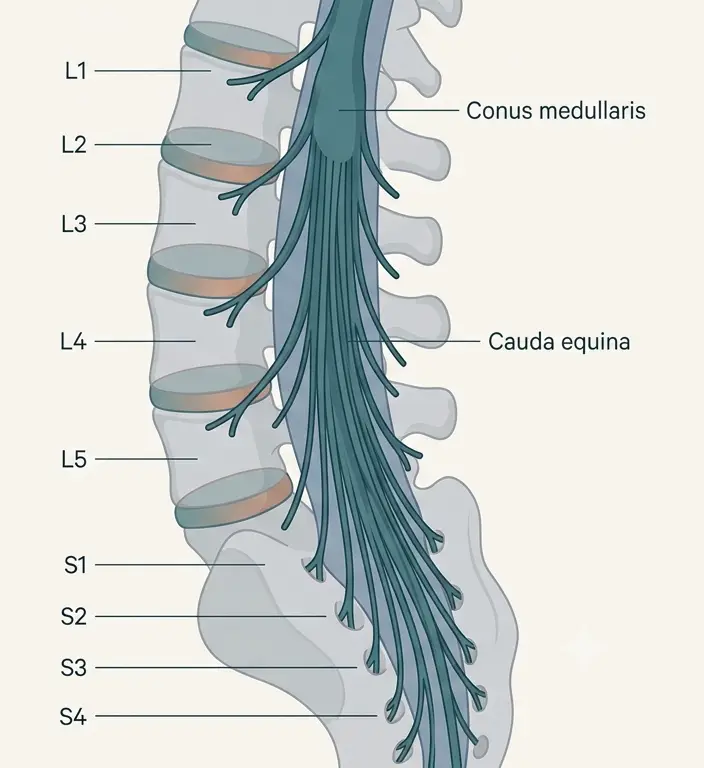
The cauda equina (Latin for 'horse's tail') is the bundle of nerve roots that descends from the lower end of the spinal cord through the lumbar spine. These nerve roots control sensation and movement in the legs, bladder, bowel, and sexual function.
When the cauda equina is severely compressed, typically by a large central disc herniation, the result is rapid compression of the nerve roots controlling the bladder, bowel, and legs. This is cauda equina syndrome: a surgical emergency.
What makes cauda equina syndrome particularly important to understand is its time-sensitivity. The evidence is consistent that outcomes are significantly better, and the risk of permanent dysfunction significantly lower, when surgical decompression occurs promptly after symptom onset. Delay worsens prognosis.
Cauda equina syndrome is rare in the context of all sciatica presentations. The large majority of people with disc herniation and sciatica will never develop it. But its rarity does not reduce its urgency, and the symptoms that indicate its onset are specific enough to recognise.
Red Flag Symptoms, What They Are and What to Do
Most sciatica is not dangerous. In the large majority of cases it responds well to structured physiotherapy management. See /sciatica/physiotherapy-treatment/ for what that looks like. But a small number of presentations require immediate emergency assessment, not physiotherapy.
The symptoms below are grouped by urgency. The grouping is clinical: not all red flags carry the same level of emergency. Symptoms in Category A require immediate A&E attendance. Categories B and C require urgent assessment on the same day or within days.
What Is Not a Red Flag
Understanding what does not constitute a red flag is as important as knowing what does. Several features of sciatica are alarming to patients but are not urgent clinical concerns.
Severe leg pain
Intense, burning, or shooting leg pain is distressing and significantly limits function, but pain severity alone is not a red flag. Many patients with acute disc herniation have extreme pain that responds to physiotherapy management without any emergency presentation. Severity of pain is not the distinguishing feature.
Weakness in one leg
Unilateral leg weakness (weakness on one side) is a common feature of lumbar nerve root compression and is typically a physiotherapy presentation. It should be assessed promptly and neurologically examined, but it does not on its own warrant A&E attendance. It is bilateral, rapidly worsening leg weakness that is the red flag.
Foot tingling or numbness on one side
Tingling, numbness, or reduced sensation in one foot is a common dermatomal pattern in sciatica, typically L5 or S1 distribution. It indicates nerve root compression and requires clinical assessment, but it is not an emergency. It is specifically saddle area numbness (the inner thighs, groin, and perineum) that is a cauda equina warning sign.
Pain that is worse at night
Many patients find sciatica more painful when lying down or at night, particularly in disc-related presentations. Night pain alone, in the context of an established sciatica pattern, is not a red flag. Night pain that is constant, severe, and completely unrelated to position, particularly in the absence of a mechanical pattern, is more concerning and warrants GP assessment.
Pain that has lasted several weeks or months
Persistent sciatica is a physiotherapy and, in some cases, a surgical consultation presentation. Duration alone does not make it a red flag. The clinical concern arises when the character of the symptoms changes, particularly if bladder, bowel, or saddle symptoms develop at any point in the timeline.
What to Expect at A&E
Most people are understandably anxious about attending A&E with these symptoms. Knowing what to expect can help. Most patients who present with suspected cauda equina symptoms will have a structured and relatively rapid assessment.
- History and neurological assessment. The emergency team will ask about your symptoms, how quickly they developed, and your background medical history. A neurological examination will be performed, including assessment of perineal and saddle sensation, lower limb strength, and reflexes.
- Urgent MRI of the lumbar spine. If the clinical assessment raises concern, an MRI will typically be arranged urgently, often the same day or overnight. This is the definitive investigation for cauda equina compression.
- Surgical team involvement. If the MRI confirms significant cauda equina compression with clinical symptoms, the spinal surgical team will be involved immediately to assess the need for and timing of decompression surgery.
- If cauda equina is not confirmed. Many patients who attend A&E with these symptoms will not have cauda equina syndrome. They will be assessed for alternative causes of their symptoms and given appropriate guidance. Attending and being discharged is a good outcome, not a wasted attendance.
Attending A&E with suspected cauda equina symptoms is always the correct clinical decision. The potential cost of not going is permanent neurological damage (Todd, 2005). Attend, and let the medical team determine the cause.
Evidence and Clinical Guidance
Clinical references and guidance cited on this page
- NationalInstitute for Health and Care Excellence. Low back pain and sciatica in over16s: assessment and management. NICE Guideline NG59. 2016 [updated 2020].Available at: www.nice.org.uk/guidance/ng59
- RoyalCollege of Emergency Medicine. Cauda Equina Syndrome clinical guidelines.Available at: www.rcem.ac.uk
- Todd NV.Cauda equina syndrome: the timing of surgery probably does influence outcome.British Journal of Neurosurgery. 2005;19(4):301–306.
- Gitelman A,Hishmeh S, Morelli BN, et al. Cauda equina syndrome: a comprehensive review.American Journal of Orthopedics. 2008;37(11):556–562.
- Fraser S,Roberts L, Murphy E. Cauda equina syndrome: a literature review of itsdefinition and clinical presentation. Archives of Physical Medicine andRehabilitation. 2009;90(11):1964–1968.
This page provides general clinical informationand does not constitute individual medical advice. If you are experiencing thesymptoms described on this page, seek emergency assessment immediately. Thispage is reviewed immediately on change to NICE, RCEM, or NCEPOD guidance.
If Your Symptoms Are Not Urgent
If you have sciatica without red flag symptoms, a clinical assessment at Atherapy will establish what is happening with your nerve, determine the most appropriate treatment approach, and give you an honest picture of your recovery pathway.
Book a Sciatica Assessment
If your symptoms are urgent: go to A&E or call 999 first. If your symptoms are not urgent and you would like a clinical assessment:
Moorgate (EC2) · Strand (WC2) · Chiswick (W4)
London Physiotherapy Team
Welcome to the Atherapy expert clinical team. We are a dedicated group of qualified physiotherapists and sports medicine specialists committed to delivering innovative, evidence-based rehabilitation. Our practice is built on a holistic approach to physical health, firmly believing that injury prevention is just as vital as the cure. From treating acute sports injuries to designing custom performance optimization programs, our clinicians work collaboratively to help you safely reach your goals.
Meet our resident experts below and find the right specialist for your recovery journey.

- With 25+ years of Premier League and Championship experience, Andrew has led Medical, Science, and Performance departments for Hull City, Nottingham Forest, Derby County, and Preston North End, following earlier work at the Manchester United Academy
- Specialist in lower limb rehabilitation
- Post-operative rehabilitation
- Back pain and complex spinal presentations
- Elite athlete management including manual therapy, gym rehabilitation and acupuncture
- Specialises in complex cases and second opinion rehabilitation planning including return to play
- Limited clinical availability due to wider clinical leadership and operational responsibilities
Andrew Balderston
Based at Moorgate

- Specialist in exercise-based rehabilitation, manual therapy and injury prevention
- Experienced in post-operative rehabilitation and progressive return to activity
- Clinical interests include sports injuries, cervical spine and low back dysfunction, shoulder, knee, foot and ankle rehabilitation
- Combines hands-on treatment with targeted strength and rehabilitation programming
- Focused on structured rehabilitation to help patients rebuild strength, movement confidence and function
- Specialist interest in women’s health support including manual lymphatic drainage during pregnancy and pre/post-natal care
- Over 15 years of clinical experience across private practice, sports rehabilitation and women’s health settings
- Fluent in English, Portuguese and Italian
Fernanda Saldanha
Based at Chiswick
- Extensive experience working within elite professional football and private practice
- Former Tottenham Hotspur Academy physiotherapist specialising in performance rehabilitation and return-to-play management
- Specialist interest in post-operative rehabilitation and upper and lower limb injury management
- Experienced in managing complex and recurrent injuries through structured, evidence-based rehabilitation planning
- Clinical approach combines manual therapy, gym-based rehabilitation, movement analysis and acupuncture
- Focused on restoring movement quality, strength under load and long-term performance outcomes
- Fluent in English and Greek
Dimitrios Michtatidis
Based at Chiswick and Strand

- Level 4 Strength & Conditioning Coach
- Medical Acupuncture & Dry Needling Qualified
- Combines detailed clinical assessment with progressive rehabilitation and strength & conditioning principles
- Specialist interest in gym-based rehabilitation and return-to-sport management
- Clinical interests include acute sporting injuries, post-operative orthopaedic rehabilitation (including ligament reconstructions, meniscal and labral repairs) and hip/groin pain in active populations
- Experience managing both active general population and performance-focused clients
- Adjunct treatment techniques include dry needling and shockwave therapy
Claire Cuffe
Based at Moorgate and Strand

- Over 5 years experience treating orthopaedic injuries, chronic pain and post operative care
- Advanced certifications in dry needling for hands, face, feet, lower limb, upper limb and lumbopelvic region
- Certified pelvic floor physio for both men and women with an interest in treating clients pre and post natal
- Special interest in strength and conditioning programming for clients training for half/full marathons