


Physiotherapy Treatment for Sciatica
By the time most people arrive at physiotherapy for sciatica, they have already spent weeks wondering whether movement is helping or making things worse. Some have been told to rest. Others have pushed through and regretted it. The uncertainty itself becomes exhausting.
The question underneath all of it is usually this: am I going to be passive in this process, or active in it? That distinction matters more than most people realise.
People are often surprised by how much of treatment is about understanding the condition rather than simply treating it. When the rationale for each intervention is clear, recovery tends to feel more purposeful and less frightening.
Most people with sciatica improve significantly with the right approach. Physiotherapy also helps identify the smaller group of patients who need imaging, injections, or surgical assessment. The process follows the clinical picture, not an ideology.
This page explains what treatment involves, why each component is included, and what to expect as sessions progress.
What Physiotherapy Treatment Involves
Physiotherapy for sciatica is not a single intervention. It is a structured clinical process that adapts as your presentation changes.
The first session is not primarily about treatment. It is about understanding your specific picture: which movements provoke symptoms, which ease them, how your nervous system is responding, and what functional goals matter most to you. Treatment follows from that assessment, not from a standard protocol.
At Atherapy, we track what matters to you at every stage, using the Patient-Specific Functional Scale (PSFS) and the Numeric Pain Rating Scale (NPRS). The PSFS asks you to score the activities your symptoms have made most difficult. Revisited at four weeks and at discharge, those scores tell us whether the programme is working and when it needs to change.
The Atherapy Recovery Continuum
Treatment for sciatica at Atherapy follows a four-stage clinical framework. Each stage has a distinct goal. Each builds on the last.
Not every patient moves through all four stages at the same pace. The assessment at Stage 1 determines how quickly progression is appropriate.
I explain to every patient that the goal of the first two weeks is not to eliminate your symptoms. It is to find the direction of movement that starts shifting your pain in the right direction, and to reduce the fear that has been keeping you from moving at all.
Dr Emma Collier PT, DPT, HCPC
Directional Loading and the McKenzie Approach
The most important question in early sciatica treatment is not how much pain you are in. It is whether your symptoms change with movement, and if so, in which direction.
In most cases of disc-related sciatica, symptoms will centralise with repeated movement in a specific direction. Centralisation means that leg or foot pain begins to move back toward the spine, even if back pain temporarily increases. Donelson et al. (Spine, 1997) identified centralisation as a reliable predictor of good outcome regardless of imaging findings.
This is assessed in the first session using repeated end-range movement in several directions, an approach known as the McKenzie Method or Mechanical Diagnosis and Therapy (MDT). The direction that centralises your symptoms becomes the foundation of your home programme from the outset.
Centralisation: what it means in plain terms
When a clinician says your symptoms are centralising, they mean the pain or tingling running into your leg is starting to withdraw toward your spine or buttock. This is a good sign, not a worsening one, even if the back pain briefly intensifies. The nerve root is becoming less irritated at its furthest point.
Browder et al. (Physical Therapy, 2007) found that patients who received direction-specific exercise had significantly better outcomes than those receiving general lumbar exercise at both short and longer-term follow-up. The difference is not the exercise itself. It is matching the movement to the individual pattern of each presentation.
Not every presentation centralises. Piriformis-related symptoms, foraminal stenosis, and sacroiliac involvement each respond differently. The assessment identifies which applies before any exercise is prescribed.
Neural Mobilisation
A compressed or irritated nerve root does not only hurt at the point of compression. Over time it can become sensitised along its length, interpreting ordinary movement as threatening.
The technique applies gentle, controlled movement to the sciatic nerve, progressively restoring its ability to move through surrounding tissue without triggering pain. Most patients begin with neural sliders, which mobilise the nerve with minimal tension, before progressing to more loaded techniques as sensitivity reduces.
It is typically introduced in the second or third session, once directional loading has begun to settle the most acute symptoms.
Manual Therapy
Manual therapy plays a supporting role in sciatica treatment. It does not address the disc or nerve root directly. What it does is restore movement in spinal segments that have stiffened in response to pain, and reduce the muscle tension around the lumbar spine and pelvis that is adding to neural compression.
For presentations involving sacroiliac joint dysfunction, restricted hip mobility, or thoracolumbar stiffness, manual therapy can produce rapid short-term improvement. That improvement creates a window for active rehabilitation. Manual therapy without active follow-through has limited lasting value.
Stynes et al. (BJGP, 2018) showed that clinical assessment findings predict nerve root involvement more accurately than imaging alone. Manual therapy decisions at Atherapy follow those findings rather than a fixed protocol.
Dry Needling
Dr Collier holds Intricate Arts Dry Needling qualifications at Level 1, 2, and 3, including Lumbopelvic specialisation. Dry needling is used as an adjunct, not as a primary treatment.
In sciatica, it is most useful in the early stages when deep gluteal and lumbar muscle tension is preventing a patient from tolerating active rehabilitation. Specific targets include the piriformis, the deep gluteal musculature, and the lumbar paraspinals. Where piriformis tension is contributing to sciatic nerve compression in the deep gluteal space, dry needling can produce a prompt reduction in referred leg symptoms.
It is followed immediately by active loading in the same session, and is offered only where tissue tension is a specific barrier to progression.
Fear-avoidance: The Treatment Target Most People Are Not Expecting
Most people attending physiotherapy for sciatica understand they will work on their back. Fewer realise that one of the most important things addressed in treatment is their relationship with movement itself.
Fear-avoidance is not a psychological weakness. It is a measurable clinical pattern: pain causes fear of movement, fear leads to avoidance, avoidance leads to deconditioning and further sensitisation, and sensitisation increases pain.
Vlaeyen and Linton (Pain, 2000) identified this cycle as the strongest single predictor of prolonged disability in people with back and leg pain, ahead of both pain severity and imaging findings. Pinheiro et al. (Pain, 2016) confirmed that catastrophising and avoidance behaviour predicted long-term outcome more reliably than initial pain intensity.
For these reasons, addressing fear-avoidance is not a secondary element of treatment. It is built into every session from the first.
"If it hurts when I move, I must be causing damage."
Pain during movement does not mean tissue damage is occurring. A sensitised nervous system responds to movement that is not genuinely harmful. Understanding this distinction is part of the treatment, not just a reassurance.
"I need to wait until the pain settles before I can exercise."
Hagen et al. (Cochrane, 2010) found no benefit from bed rest compared to staying active. Waiting for pain to disappear before moving is the pattern that tends to prolong recovery, not shorten it.
"My scan shows serious damage. Exercise could make it worse."
Brinjikji et al. (AJNR, 2015) found disc changes in 37% of asymptomatic 20-year-olds and over 90% of asymptomatic 60-year-olds. The scan describes structure. It is not a guide to what you are capable of doing.
Part of treatment is gradually reintroducing the movements and activities your nervous system has begun to treat as threatening. This is not pushing through pain. It is a supported, evidence-based process of helping the nervous system learn that movement is safe.
It begins in session one. Fernandez et al. (BJSM, 2022) demonstrated that active rehabilitation including graded exposure produced better outcomes for sciatica than passive treatment at six months and beyond, reducing both disability and recurrence.
What to expect as sessions progress
Early sessions (weeks 1 to 2)
- Detailed movement and neural assessment to identify centralisation direction and neural sensitivity
- Direction-specific home exercise prescribed on the basis of your individual findings
- Education on the fear-avoidance pattern and the evidence on movement safety during nerve root pain
- Manual therapy or dry needling where indicated to reduce barriers to active loading
- Baseline PSFS and NPRS scores recorded so progress can be tracked against what matters to you
Middle phase (weeks 3 to 6)
- Progression from symptom-relieving movement to spinal loading and stability work
- Neural mobilisation introduced and progressed as nerve sensitivity reduces
- Graded return to work, training, or functional activities specific to your goals
- PSFS review at four weeks: a direct comparison against your baseline scores
- Programme adaptation based on your response
Later phase (weeks 6 to discharge)
- Strengthening and loading progression across the hip, lumbar spine, and lower limb
- Return to performance demands: sustained sitting, heavy loading, sporting or occupational movements
- Discharge planning with a self-management programme to reduce recurrence risk
- Final PSFS and NPRS scores compared to baseline to confirm outcome
How Long Does Treatment Take
Most patients with acute disc-related sciatica show meaningful improvement within six to eight weeks of active physiotherapy. Chiu et al. (Clinical Rehabilitation, 2015) found that over 90% of disc prolapses show partial or complete reabsorption within twelve months, and that active rehabilitation supports the clinical improvement that accompanies that natural process.
A typical episode for an acute presentation involves eight to twelve sessions over six to ten weeks. Presentations with significant fear-avoidance, long-standing sensitisation, or demanding functional goals may take longer.
Peul et al. (NEJM, 2007) found that surgery and conservative management produced equivalent outcomes at one to two years for most patients with lumbar disc herniation. The difference was in the speed of early symptom relief, not long-term recovery. For patients who have not had surgery, active physiotherapy from the outset remains the most strongly evidenced first-line approach, as outlined in NICE Guideline NG59 (2020).
The Evidence For Active Rehabilitation
What the clinical evidence shows
- Active over passive. Fernandez et al. (BJSM, 2022) found that active rehabilitation produced significantly better outcomes for sciatica at six months than passive treatment, with lower disability scores and reduced recurrence.
- Directional exercise works. Browder et al. (Physical Therapy, 2007) demonstrated that direction-specific exercise outperformed non-specific lumbar exercise at all follow-up points, particularly for leg symptom reduction.
- Fear predicts outcome. Vlaeyen and Linton (Pain, 2000) identified fear-avoidance as the strongest predictor of prolonged disability, ahead of pain severity, imaging findings, and physical capacity.
- Psychological factors matter long-term. Pinheiro et al. (Pain, 2016) found that catastrophising and avoidance predicted six-month outcome more accurately than baseline pain intensity.
- Bed rest does not help. Hagen et al. (Cochrane, 2010) found no benefit from bed rest for acute low back pain or radiculopathy. Staying active is consistently associated with faster recovery.
- Physiotherapy is first-line. NICE Guideline NG59 (updated 2020) recommends active physiotherapy as the primary treatment for sciatica, without routine imaging, except where red flags are present.
Common beliefs about sciatica treatment
GOOD PROGNOSTIC SIGNS
Signs that usually respond well to active management
- Symptoms centralise with a specific direction of movement in the assessment
- Pain is intermittent rather than constant, even if severe at its worst
- Symptoms have been present for less than twelve weeks
- You can identify positions or movements that provide some relief
- You are willing to understand the fear-avoidance pattern and work with it
- Neurological signs such as weakness or reflex change are mild or absent
Clinical Case Study
The patients who do best are not necessarily those with the mildest presentations.They are the ones who understand early that movement-based rehabilitation is the primary driver of recovery, and that the discomfort of early loading is part of the process, not a sign that something is going wrong.
Dr Emma Collier PT, DPT, HCPC
What Effective Physiotherapy Looks Like
Effective physiotherapy for sciatica is specific, progressive, and designed around restoring function rather than temporary symptom reduction alone. It follows a clear clinical rationale, adapts to your response, and addresses both the physical source of nerve irritation and the fear-avoidance behaviour that can sustain it.
NICE NG59 (2020) recommends against bed rest and against passive management as a primary treatment approach. Where imaging shows severe neural compression with progressive neurological deficit, referral for surgical assessment is the appropriate step. Recognising when that step is warranted is part of clinical care.
The aim is not simply short-term comfort, but restoring long-term function and confidence in movement.
The trend matters more than the day. If the overall direction over two to three weeks is toward less leg pain and more function, that is a good treatment response, even if individual sessions feel demanding.
Dr Emma Collier PT, DPT, HCPC
The body knows how to recover. The goal of treatment is not simply to reduce pain, but to help you return to moving with confidence. The earlier that process becomes specific and structured, the more consistent recovery tends to be.
Ready to start treatment
If you have already had an assessment and know what is causing your symptoms, the next step is a treatment programme directed at the specific source. If you have not yet had a formal assessment, that is where we start.
Clinics: Moorgate (EC2) | Strand (WC2) | Chiswick (W4)
Book a Physiotherapy Appointment
Key Evidence
- Browder et al. British Journal of Sports Medicine. 2007. Direction-specific exercise superior to non-specific lumbar exercise for patients with low back pain and directional preference.
- Chiu et al. Clinical Rehabilitation. 2015. Spontaneous regression of disc prolapses in conservatively managed patients.
- Donelson et al. Spine. 1997. Centralisation during movement testing as a prognostic indicator for directional preference.
- Fernandez et al. British Journal of Sports Medicine. 2022. Active rehabilitation versus passive treatment for sciatica.
- Hagen et al. Cochrane Database. 2010. Bed rest compared with continued activity for low back pain and radiculopathy.
- NICE Guideline NG59. 2016 (updated 2020). Low back pain and sciatica in over 16s: assessment and management.
- Peul et al. New England Journal of Medicine. 2007. Surgery versus prolonged conservative treatment for sciatica.
- Pinheiro et al. Pain. 2016. Psychological factors as predictors of long-term outcome in sciatica.
- Stynes et al. British Journal of General Practice. 2018. Clinical features predicting nerve root involvement in patients with back-related leg pain.
- Vlaeyen and Linton. Pain. 2000. Fear-avoidance and its consequences in chronic musculoskeletal pain.
- Brinjikji et al. American Journal of Neuroradiology. 2015. Systematic review of imaging features in asymptomatic adults.
London Physiotherapy Team
Welcome to the Atherapy expert clinical team. We are a dedicated group of qualified physiotherapists and sports medicine specialists committed to delivering innovative, evidence-based rehabilitation. Our practice is built on a holistic approach to physical health, firmly believing that injury prevention is just as vital as the cure. From treating acute sports injuries to designing custom performance optimization programs, our clinicians work collaboratively to help you safely reach your goals.
Meet our resident experts below and find the right specialist for your recovery journey.

- With 25+ years of Premier League and Championship experience, Andrew has led Medical, Science, and Performance departments for Hull City, Nottingham Forest, Derby County, and Preston North End, following earlier work at the Manchester United Academy
- Specialist in lower limb rehabilitation
- Post-operative rehabilitation
- Back pain and complex spinal presentations
- Elite athlete management including manual therapy, gym rehabilitation and acupuncture
- Specialises in complex cases and second opinion rehabilitation planning including return to play
- Limited clinical availability due to wider clinical leadership and operational responsibilities
Andrew Balderston
Based at Moorgate

- Specialist in exercise-based rehabilitation, manual therapy and injury prevention
- Experienced in post-operative rehabilitation and progressive return to activity
- Clinical interests include sports injuries, cervical spine and low back dysfunction, shoulder, knee, foot and ankle rehabilitation
- Combines hands-on treatment with targeted strength and rehabilitation programming
- Focused on structured rehabilitation to help patients rebuild strength, movement confidence and function
- Specialist interest in women’s health support including manual lymphatic drainage during pregnancy and pre/post-natal care
- Over 15 years of clinical experience across private practice, sports rehabilitation and women’s health settings
- Fluent in English, Portuguese and Italian
Fernanda Saldanha
Based at Chiswick
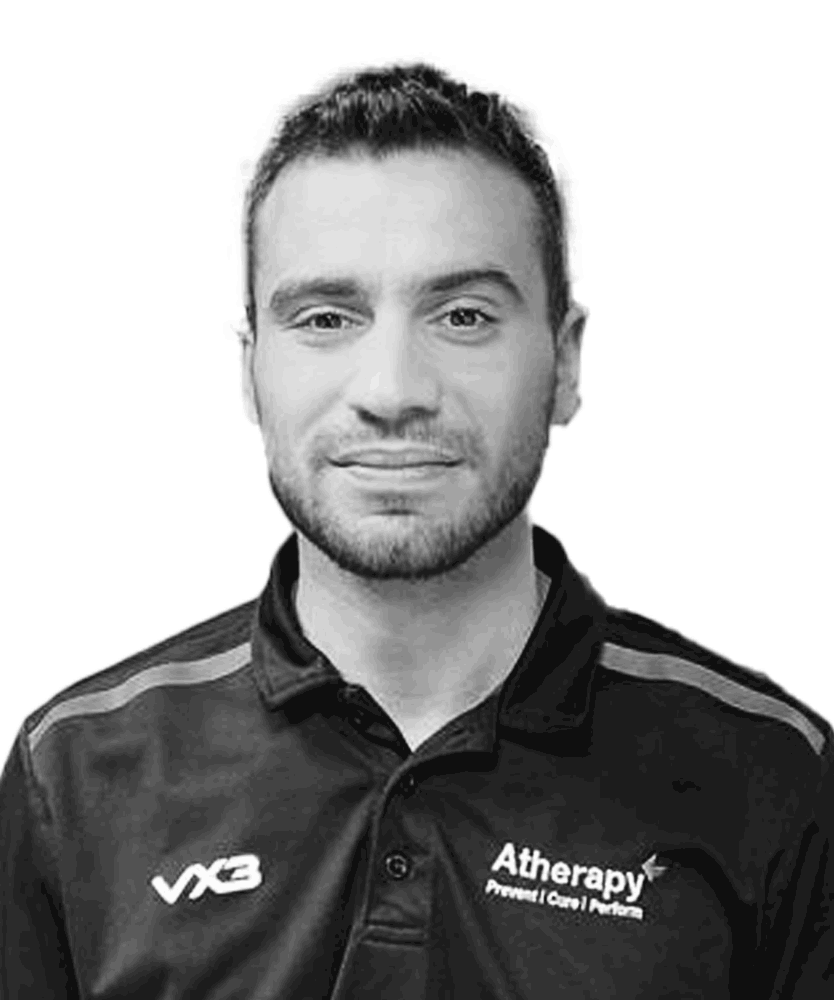
- Extensive experience working within elite professional football and private practice
- Former Tottenham Hotspur Academy physiotherapist specialising in performance rehabilitation and return-to-play management
- Specialist interest in post-operative rehabilitation and upper and lower limb injury management
- Experienced in managing complex and recurrent injuries through structured, evidence-based rehabilitation planning
- Clinical approach combines manual therapy, gym-based rehabilitation, movement analysis and acupuncture
- Focused on restoring movement quality, strength under load and long-term performance outcomes
- Fluent in English and Greek
Dimitrios Michtatidis
Based at Chiswick and Strand

- Level 4 Strength & Conditioning Coach
- Medical Acupuncture & Dry Needling Qualified
- Combines detailed clinical assessment with progressive rehabilitation and strength & conditioning principles
- Specialist interest in gym-based rehabilitation and return-to-sport management
- Clinical interests include acute sporting injuries, post-operative orthopaedic rehabilitation (including ligament reconstructions, meniscal and labral repairs) and hip/groin pain in active populations
- Experience managing both active general population and performance-focused clients
- Adjunct treatment techniques include dry needling and shockwave therapy
Claire Cuffe
Based at Moorgate and Strand

- Over 5 years experience treating orthopaedic injuries, chronic pain and post operative care
- Advanced certifications in dry needling for hands, face, feet, lower limb, upper limb and lumbopelvic region
- Certified pelvic floor physio for both men and women with an interest in treating clients pre and post natal
- Special interest in strength and conditioning programming for clients training for half/full marathons