

Sciatica Not Improving
You have been doing the exercises. You have rested when it flared. You have been patient. And it is still there.
That experience — weeks of effort with little to show for it — is one of the most demoralising things patients describe. It often comes with real anxiety: if it has not improved by now, what does that mean?
Persistent sciatica almost always has a reason, and the reason is almost always identifiable. This page explains what drives plateaus, how to read what your symptom pattern is telling you, and what a revised clinical approach can offer.
Why Sciatica Takes Longer for Some People Than Others
Most acute sciatica resolves. Chiu et al. (2015) found that disc material reabsorbs spontaneously in around 90% of cases, and that larger herniations are actually more likely to reabsorb than smaller ones. But the timeline varies considerably — depending on the size and position of the herniation, the level of nerve irritation, and how the spine is being loaded between sessions.
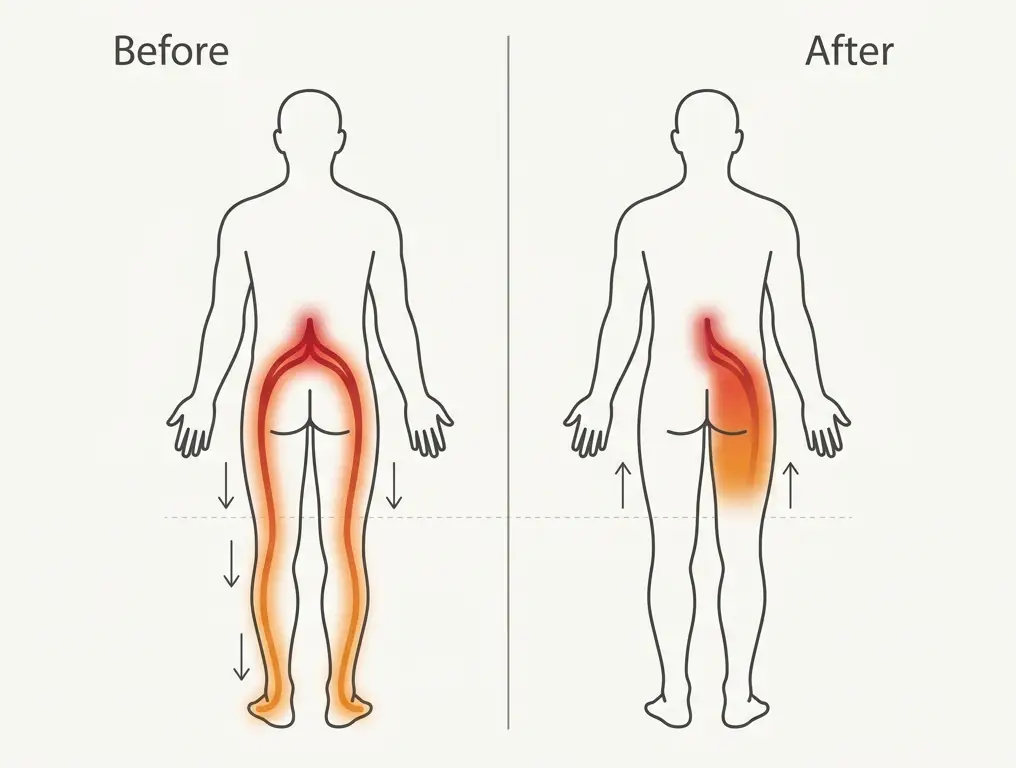
"Not improving" is worth defining carefully. Some patients mean the pain has not changed at all. Others mean it has changed but not in the direction they expected: the leg pain is less but the back stiffness is worse, or the tingling has moved. Centralisation — pain moving from the leg toward the spine — is a positive sign even when it does not feel like one. It is the clearest indicator that the disc is responding and the nerve root is decompressing.
Slow progress is not the same as no progress. Centralisation is one of the strongest predictors of a good outcome, even when it feels like things are getting worse.
Understanding Irritability: The Variable Most Programmes Miss
Before directional preference can be addressed, irritability needs to be classified. Irritability describes how sensitised the nervous system currently is — how easily symptoms are provoked, and how long they take to settle. Getting this wrong is where most treatment courses come unstuck. A programme appropriate for a low-irritability presentation can significantly worsen a high-irritability one.
“Irritability classification comes before directional preference. It determines the dosage, the range, the frequency — and often whether to start with movement at all.”
Dr Emma Collier PT, DPT
The Most Common Reasons Recovery Stalls
A plateau is rarely bad luck. A thorough re-assessment almost always finds something identifiable.
Wrong Directional Bias
Most disc-related sciatica responds to movement in one direction and worsens with the other. Extension-bias is far more common than flexion-bias, but not universal. Patients prescribed exercises in the wrong direction often plateau quickly. The exercises are not wrong in the abstract — they are wrong for this person, in this direction, at this presentation.
Irritability Not Adequately Managed
In a high-irritability presentation, introducing directional loading exercises at normal volumes can worsen sensitisation rather than resolve it. The appropriate approach is to reduce irritability first — through posture modification, activity pacing, and very low-dose movement — before introducing directional loading. Skipping this step is one of the most common reasons initial treatment fails.
Clinical picture:
Frequency and Postural Loading
Too little frequency of centralising movement means gains are undone by aggravating postures before the next session. For directional preference to drive recovery, the centralising movement needs to be repeated often enough to maintain a directional bias across the day — not performed once, then counteracted by hours of loading in the opposite direction. Daily posture is the hidden variable: the programme is incomplete if it addresses only the exercise component and ignores what happens between sessions.
What Your Plateau Pattern Is Actually Telling You
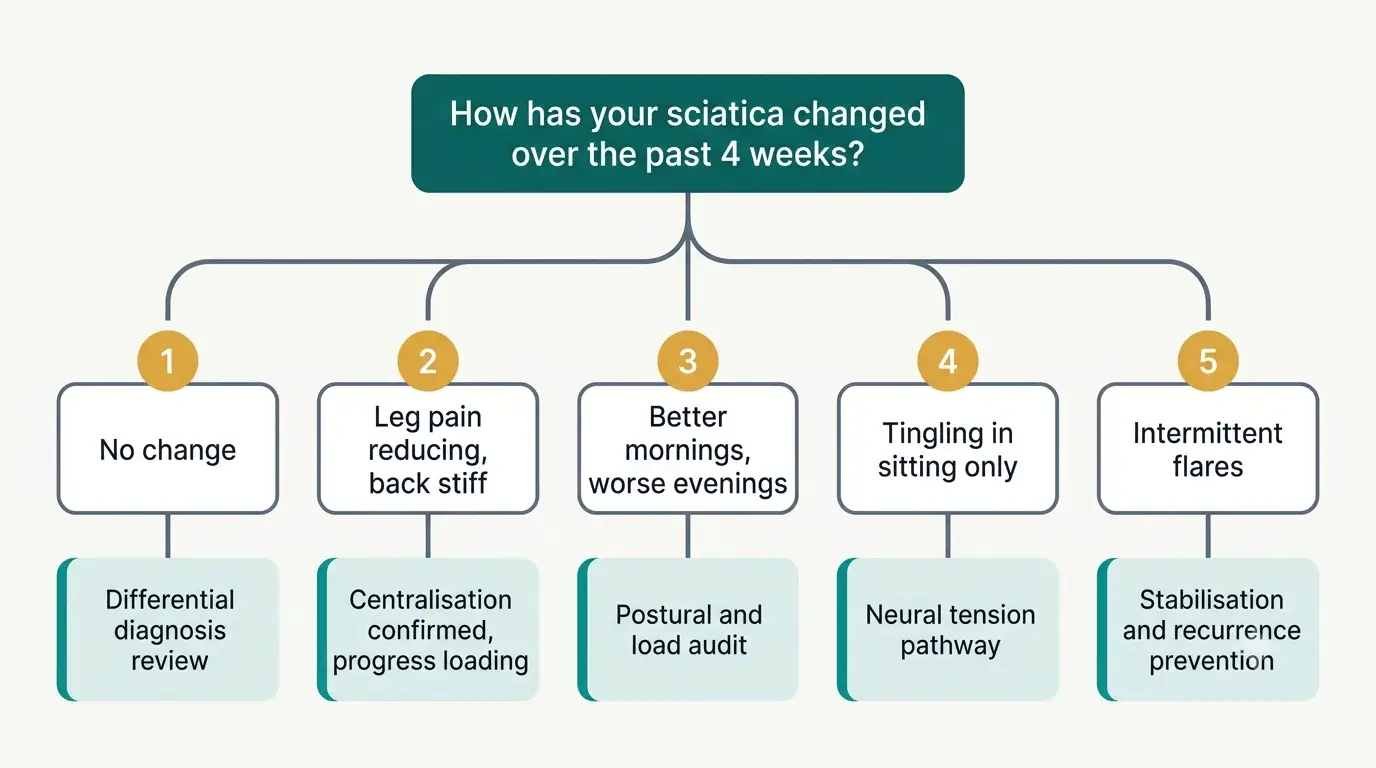
Not all plateaus look the same. The specific pattern of symptoms — what has changed, what has not, what time of day things shift, where exactly the pain sits — contains clinical information. The table below describes five common plateau patterns and what each usually indicates.
When the Diagnosis May Need Revisiting
Not all leg pain running from the buttock is disc-related sciatica. A presentation that fails to centralise with directional movement after six to eight weeks on a well-structured programme warrants asking whether the original diagnosis is complete.
Piriformis Syndrome and Deep Gluteal Syndrome
The sciatic nerve can be compressed within the deep gluteal space rather than at the nerve root. Martin et al. (2015) described deep gluteal syndrome as a consistently underdiagnosed cause that does not respond to spinal-directed treatment because the compression is extraspinal. Clinical differentiators: pain reproduced by hip rotation under load, a positive FAIR test, normal spinal provocation responses.
SIJ Dysfunction
Sacroiliac joint dysfunction refers pain into the buttock and posterior thigh in a pattern overlapping significantly with disc-related sciatica. Laslett et al. (2005) found that a cluster of three or more positive SIJ provocation tests had good diagnostic accuracy. SIJ-sourced pain does not centralise with directional movement and does not respond to nerve mobilisation.
Lateral Recess Stenosis vs Central Stenosis
These compress the neural structures differently and require different treatment. Lateral recess stenosis: unilateral, position-dependent symptoms. Central stenosis: bilateral symptoms, worsened by extension and walking, relieved by flexion and sitting.
The Role of Imaging
An MRI report is one of the most consistent drivers of fear in sciatica management. Patients read about disc bulges and nerve compression and interpret this as serious structural damage — increasing anxiety and reducing movement at exactly the wrong moment.
What Imaging Findings Actually Mean
Brinjikji et al. (AJNR, 2015) reviewed imaging findings in asymptomatic people. At age 40, disc degeneration was present in around 68%. At age 50, disc bulging in around 40%. These are normal age-related changes. An MRI finding a disc herniation identifies where structural change is present. It does not identify it as the source of current symptoms, and it does not tell you what treatment is needed.
When Imaging is Indicated
Imaging answers a specific clinical question. It is appropriate when there is suspicion of cauda equina syndrome, progressive neurological deficit, failure to improve after twelve weeks of adequate management, or when surgical assessment is being considered. Outside these criteria, reassessment by a physiotherapist produces more actionable information.
Indications for imaging in sciatica
✓ Bladder or bowel dysfunction (urgent — possible cauda equina)
✓ Bilateral leg symptoms with saddle numbness (urgent)
✓ Progressive neurological deficit: worsening weakness or spreading numbness
✓ No meaningful improvement after twelve weeks of adequate conservative management
✓ Surgical assessment is being actively considered
✓ Significant trauma associated with symptom onset
Fear-Avoidance: The Physiological Driver Nobody Explains
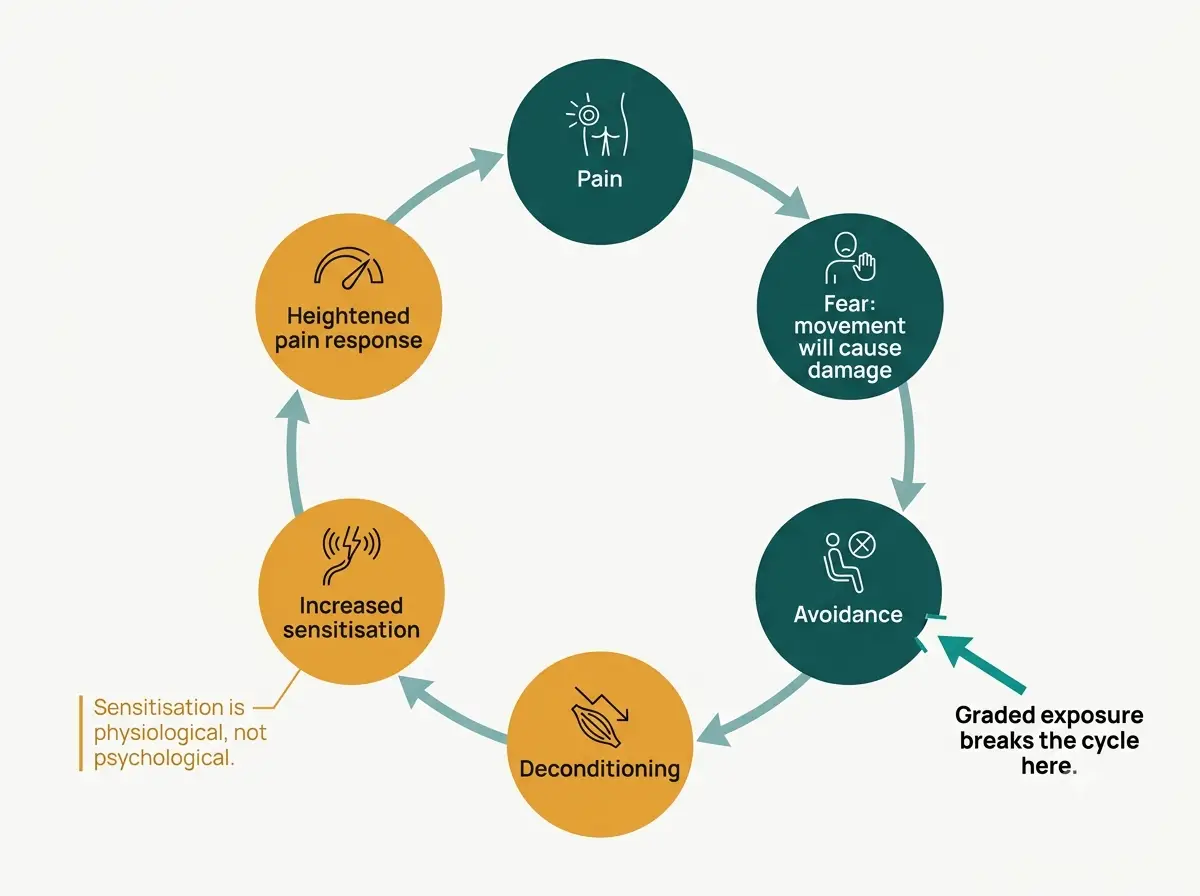
When pain has persisted beyond six to eight weeks, fear-avoidance is almost always contributing. This is not a psychological dismissal — it is a physiological mechanism, one of the most robustly evidenced in musculoskeletal medicine.
The mechanism: when movement provokes pain and that pain is interpreted as a sign of ongoing damage, the nervous system learns to avoid that movement. Avoidance leads to deconditioning, deconditioning increases pain sensitivity, and increased sensitivity produces more avoidance. The cycle does not resolve on its own.
Addressing it is a clinical task — building a graduated sequence of movement experiences that give the nervous system new data. Not pushing through fear, but making the fear unnecessary.
“We do not ask patients to push through fear. We give them experiences that make the fear unnecessary. That is a meaningful clinical distinction.”
Dr Emma Collier PT, DPT
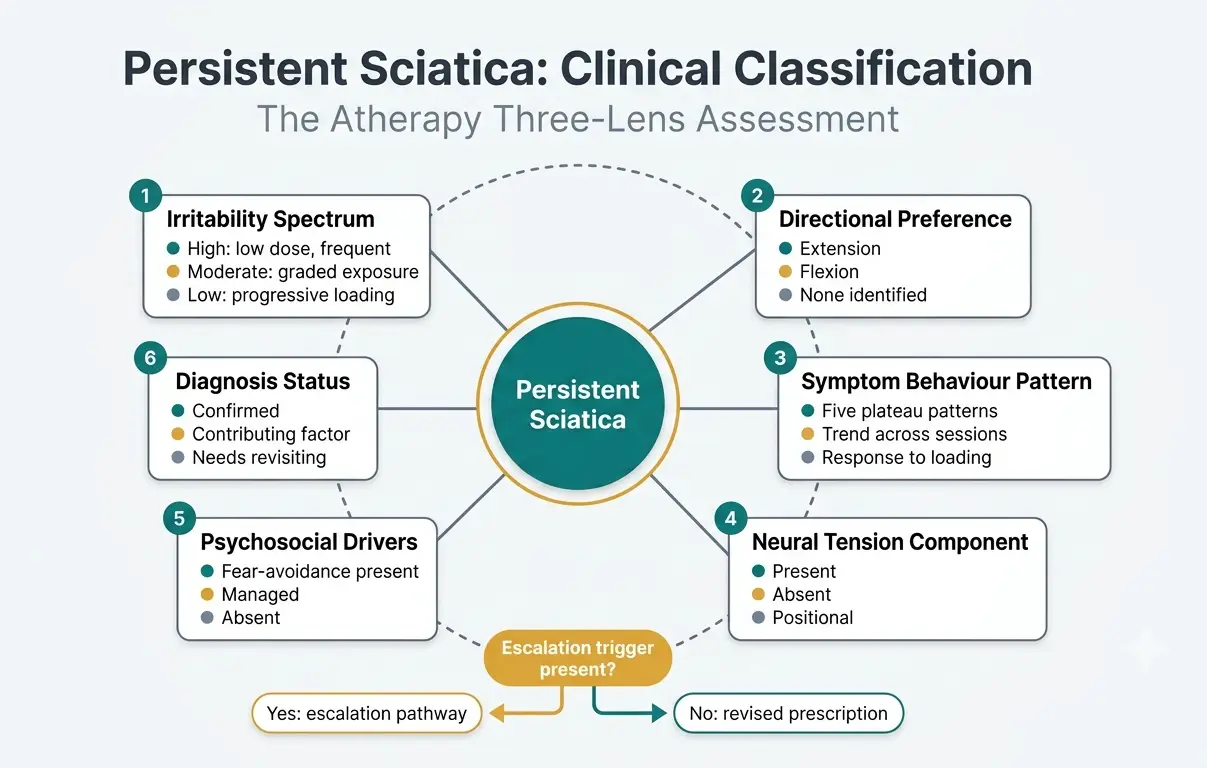
The Atherapy Three-Lens Assessment
A re-assessment at Atherapy for persistent sciatica uses a structured clinical framework called the Three-Lens Assessment — a targeted investigation of why this specific presentation has not responded, built around three clinical questions that determine where recovery has stalled.
The Atherapy Three-Lens Assessment for persistent sciatica
Lens 1 — Irritability: what is the current sensitisation level, and has it changed since treatment began? Is the presentation now testable that was not before?
Lens 2 — Directional behaviour: has directional preference been confirmed under load? Is the current exercise direction producing centralisation or peripheralisation?
Lens 3 — Symptom behaviour: what does the daily pattern of symptoms tell us? What worsens, what improves, at what time of day, in what positions? This is where the plateau usually lives.
We prioritise movement behaviour over imaging severity. We build the clinical approach from what the presentation shows us, not from the report. And we address the postural load between sessions — the hours of sitting, the commute, the sleep position — as explicitly as the exercises themselves.
“A reassessment changes the treatment because the presentation has changed. We are not repeating the initial assessment — we are examining what the same patient looks like now, with a treatment history to work from.”
Dr Emma Collier PT, DPT
The Escalation Pathway
When an accurate, irritability-matched, directionally correct programme has genuinely been tried and found inadequate, there is a clear clinical pathway.
Step 1: Physiotherapy reassessment (any stage)
✓ Re-assess irritability classification and current directional behaviour
✓ Review the programme: direction, frequency, postural loading between sessions
✓ Identify and address fear-avoidance if present
✓ Confirm or revise the working diagnosis
Step 2: Pain management referral (weeks 8-12)
✓ Indicated when symptoms are not centralising and function is significantly impaired
✓ Addresses the sensitisation component through pain education and graded activity
Step 3: Spinal injection (typically weeks 12+)
✓ Epidural steroid injection reduces nerve root inflammation
✓ Creates a window of reduced pain in which rehabilitation can progress
✓ Evidence of effect strongest at 6-12 weeks post-injection (NICE NG59)
Step 4: Surgical assessment (weeks 12+, specific criteria)
✓ Considered when neurological deficit is progressive or when conservative management has genuinely failed over twelve weeks
✓ Peul et al. (NEJM, 2007): early surgery produced faster short-term relief; equivalent outcomes to conservative management at one year
✓ Surgery is not a failure of physiotherapy — it is one clinical option in a pathway with specific indications
If you have been told there is nothing more to try...
A Different Clinical Lens Often Changes Everything
Sciatica that has not responded to one approach often responds well to a different one. Our assessment at Atherapy is not a repeat of what you have already had — we are looking at what has been tried, what has not, and what the symptom behaviour is actually telling us.
Moorgate EC2 | Strand WC2 | Chiswick W4
What a Revised Physiotherapy Assessment Looks Like
Re-assessment is not starting from scratch. It is a targeted review of what has been tried, what effect it has had, and what the current presentation — which has evolved since the initial appointment — is now telling us.
The re-assessment typically finds one or more of the following: irritability was higher than the programme assumed; directional preference was present but exercise frequency too low; a postural factor was undoing progress between sessions; a contributing diagnosis was not addressed; fear-avoidance had established itself as a driver. Each of these is addressable.
What a re-assessment at Atherapy covers
✓ Full symptom behaviour review: what has improved, what has not moved, what makes it worse
✓ Irritability re-classification: is the presentation now testable that was not before?
✓ Directional preference re-testing: has the pattern shifted since initial assessment?
✓ Posture and daily loading audit: what is happening between sessions?
✓ Neurological screen: is there progressive deficit requiring escalation?
✓ Psychosocial screen: is fear-avoidance now a significant driver?
✓ Diagnosis review: does the presentation still fit, or is a second diagnosis contributing?
Sciatica not improving despite weeks of effort?
The Problem Is Usually the Prescription
Most plateaus in sciatica recovery are reversible once the prescription is corrected. The exercises may be sound in principle but wrong for this presentation, this direction, this irritability level. A single assessment is usually enough to identify what needs to change.
Moorgate EC2 | Strand WC2 | Chiswick W4
Key Evidence
This page draws on the following peer-reviewed sources and clinical guidelines:
- Chiu CC, et al. The probability of spontaneous regression of lumbar herniated disc: a systematic review. Clinical Rehabilitation. 2015;29(2):184-195.
- Peul WC, et al. Surgery versus prolonged conservative treatment for sciatica. New England Journal of Medicine. 2007;356(22):2245-2256.
- National Institute for Health and Care Excellence. Low back pain and sciatica in over 16s: assessment and management. NICE guideline NG59. 2016, updated 2020.
- Hagen KB, et al. The updated Cochrane review of bed rest for low back pain and sciatica. Spine. 2005;30(5):542-546.
- Vlaeyen JW, Linton SJ. Fear-avoidance and its consequences in chronic musculoskeletal pain. Pain. 2000;85(3):317-332.
- Pinheiro MB, et al. Presence and characteristics of central sensitization in chronic musculoskeletal pain. Pain. 2018;159(4):674-683.
- Brinjikji W, et al. Systematic literature review of imaging features of spinal degeneration in asymptomatic populations. American Journal of Neuroradiology. 2015;36(4):811-816.
- Martin HD, et al. The pattern of pain and numbness in patients with sciatic nerve entrapment in the deep gluteal space. Arthroscopy. 2015;31(8):1540-1548.
- Laslett M, et al. Diagnosis of sacroiliac joint pain: validity of individual provocation tests and composites of tests. Manual Therapy. 2005;10(3):207-218.
- Stynes S, et al. Classification of patients with low back-related leg pain: a systematic review. BMC Musculoskeletal Disorders. 2016;17(1):226.
- Fernandez M, et al. Rehabilitation following first-time lumbar disc surgery. British Journal of Sports Medicine. 2022;56(22):1281-1291.
Evidence cited reflects peer-reviewed literature available at time of authorship. Clinical guidelines are NICE NG59 (2020 revision). This page does not constitute medical advice. Patients should seek individual clinical assessment for their specific presentation.
London Physiotherapy Team
Welcome to the Atherapy expert clinical team. We are a dedicated group of qualified physiotherapists and sports medicine specialists committed to delivering innovative, evidence-based rehabilitation. Our practice is built on a holistic approach to physical health, firmly believing that injury prevention is just as vital as the cure. From treating acute sports injuries to designing custom performance optimization programs, our clinicians work collaboratively to help you safely reach your goals.
Meet our resident experts below and find the right specialist for your recovery journey.

- With 25+ years of Premier League and Championship experience, Andrew has led Medical, Science, and Performance departments for Hull City, Nottingham Forest, Derby County, and Preston North End, following earlier work at the Manchester United Academy
- Specialist in lower limb rehabilitation
- Post-operative rehabilitation
- Back pain and complex spinal presentations
- Elite athlete management including manual therapy, gym rehabilitation and acupuncture
- Specialises in complex cases and second opinion rehabilitation planning including return to play
- Limited clinical availability due to wider clinical leadership and operational responsibilities
Andrew Balderston
Based at Moorgate

- Specialist in exercise-based rehabilitation, manual therapy and injury prevention
- Experienced in post-operative rehabilitation and progressive return to activity
- Clinical interests include sports injuries, cervical spine and low back dysfunction, shoulder, knee, foot and ankle rehabilitation
- Combines hands-on treatment with targeted strength and rehabilitation programming
- Focused on structured rehabilitation to help patients rebuild strength, movement confidence and function
- Specialist interest in women’s health support including manual lymphatic drainage during pregnancy and pre/post-natal care
- Over 15 years of clinical experience across private practice, sports rehabilitation and women’s health settings
- Fluent in English, Portuguese and Italian
Fernanda Saldanha
Based at Chiswick

- Extensive experience working within elite professional football and private practice
- Former Tottenham Hotspur Academy physiotherapist specialising in performance rehabilitation and return-to-play management
- Specialist interest in post-operative rehabilitation and upper and lower limb injury management
- Experienced in managing complex and recurrent injuries through structured, evidence-based rehabilitation planning
- Clinical approach combines manual therapy, gym-based rehabilitation, movement analysis and acupuncture
- Focused on restoring movement quality, strength under load and long-term performance outcomes
- Fluent in English and Greek
Dimitrios Michtatidis
Based at Chiswick and Strand

- Level 4 Strength & Conditioning Coach
- Medical Acupuncture & Dry Needling Qualified
- Combines detailed clinical assessment with progressive rehabilitation and strength & conditioning principles
- Specialist interest in gym-based rehabilitation and return-to-sport management
- Clinical interests include acute sporting injuries, post-operative orthopaedic rehabilitation (including ligament reconstructions, meniscal and labral repairs) and hip/groin pain in active populations
- Experience managing both active general population and performance-focused clients
- Adjunct treatment techniques include dry needling and shockwave therapy
Claire Cuffe
Based at Moorgate and Strand

- Over 5 years experience treating orthopaedic injuries, chronic pain and post operative care
- Advanced certifications in dry needling for hands, face, feet, lower limb, upper limb and lumbopelvic region
- Certified pelvic floor physio for both men and women with an interest in treating clients pre and post natal
- Special interest in strength and conditioning programming for clients training for half/full marathons