

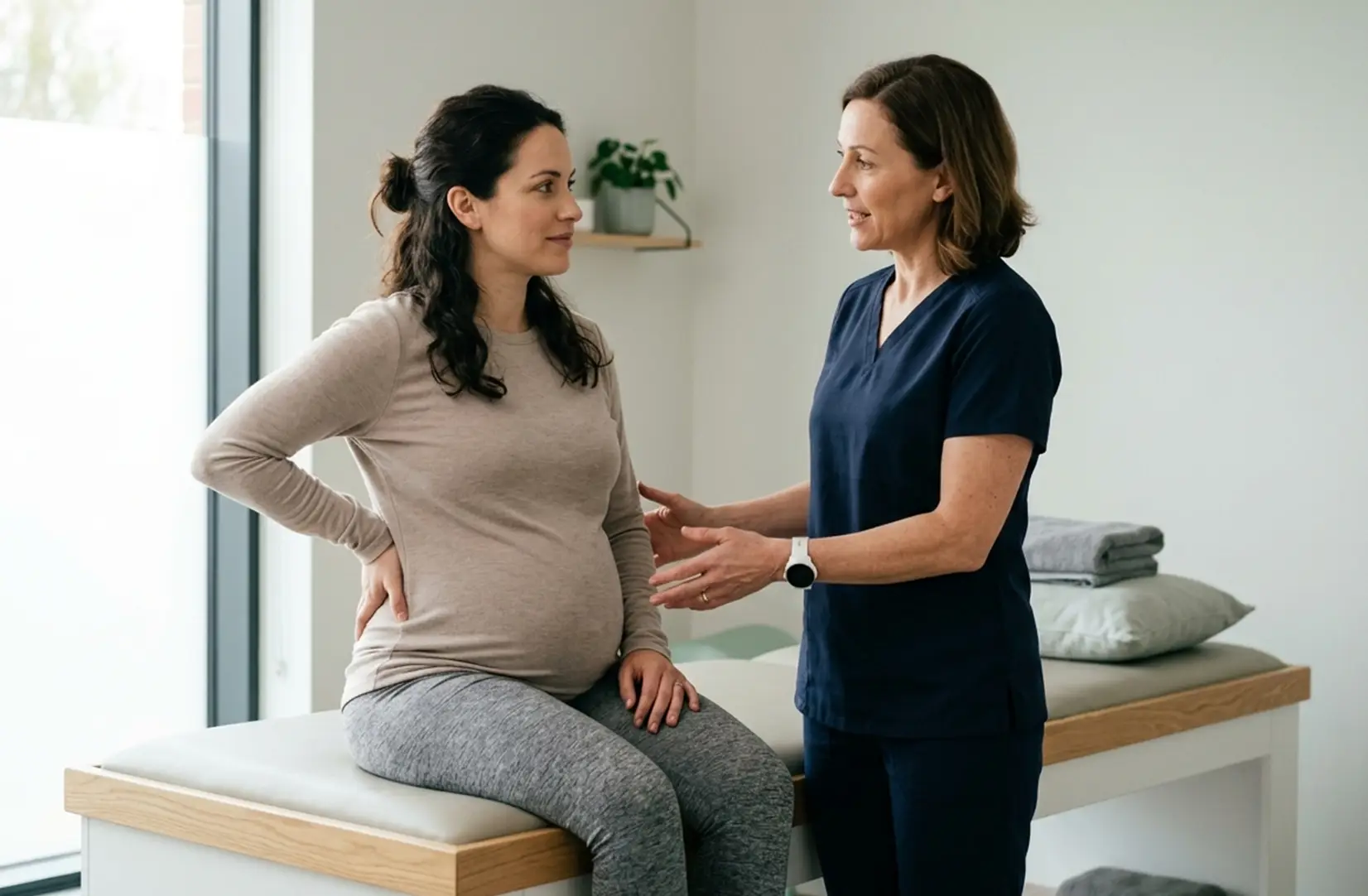
Sciatica During Pregnancy
Why it happens, what it feels like, and how specialist physiotherapy can help you move more comfortably through the rest of your pregnancy.
Most women with sciatica during pregnancy say the same thing: they did not expect it, they are not sure what has caused it, and they are frightened of doing something that makes it worse. If any of that sounds familiar, this page is for you.
Sciatica during pregnancy is common, it has clear physiological causes, and it responds well to the right treatment. The overall prognosis for pregnancy-related sciatica is very good. Understanding what is happening is usually the first step towards feeling better.
Quick Answers
- Sciatica during pregnancy is common and is caused by specific physiological changes, not by anything you have done wrong.
- Physiotherapy is safe throughout pregnancy and is the recommended first-line treatment by NICE Guideline NG59.
- Appropriately selected exercises do not harm the baby. Staying gently active is usually better than resting.
- Most pregnancy-related sciatica improves significantly after delivery. The overall prognosis is very good.
- Cauda equina symptoms and obstetric warning signs require immediate emergency attention.
What Pregnancy Sciatica Often Feels Like
No two people describe sciatica in exactly the same way. But there are patterns that many pregnant women recognise immediately.
The most common description is a sharp, shooting, burning, or electric pain that starts in the lower back or buttock and travels down the back of the leg, sometimes reaching the calf or foot. It is often one-sided. It is often worse during or after certain movements.
Many women describe these moments specifically:
- Turning over in bed: sharp pain through the buttock or hip, sometimes making it necessary to roll very slowly
- Getting in or out of the car: a catch or shooting sensation as the hip flexes under load
- Standing for more than a few minutes: a deep ache building through the lower back and into the leg
- Walking: often better initially, then worsening after a certain distance
- Sitting for prolonged periods: especially on soft surfaces, with the hip in a flexed position
- Tingling or numbness in the calf or foot at night, sometimes waking you
- One-sided buttock pain after standing asymmetrically, shifting weight to one side
Many women feel frustrated or guilty that pain is limiting what they expected pregnancy to feel like. If several of these experiences sound familiar, you are not imagining it and you are not being dramatic. These are recognised patterns of sciatic nerve irritation in pregnancy, and they respond to treatment.
Why Sciatica Happens During Pregnancy
Pregnancy creates a specific combination of changes that make sciatic nerve irritation more likely. These are not causes for alarm. They are predictable changes that a physiotherapist who works with pregnant patients understands in detail.
The role of relaxin
Your body produces a hormone called relaxin during pregnancy. Its purpose is to soften the ligaments of the pelvis, allowing the joint changes needed for childbirth. As a side effect, it also increases load and movement through the lumbar discs and sacroiliac joints. Vermani, Mittal and Weeks (Pain Practice, 2010) identified ligament laxity from relaxin as one of the primary mechanisms behind pregnancy-related lower back and pelvic pain. When pelvic support structures become less taut, the lumbar discs work harder. The sciatic nerve runs in close proximity to these structures.
Postural change and lower back load
As your bump grows, your centre of gravity shifts forward. Most women adapt by increasing the curve in the lower back and tilting the pelvis forwards. This is completely natural and largely unconscious. It does, however, place additional compressive load on the lower lumbar segments, particularly the levels from which the sciatic nerve most commonly originates. Over weeks and months, that sustained load can be enough to irritate the nerve, even without a disc herniation.
Fetal position and muscle tension
Later in pregnancy, the position of the baby can directly influence sciatic symptoms. A posterior fetal position can place pressure on the piriformis muscle, which sits very close to the sciatic nerve as it passes through the buttock. This can produce pain and tingling that feels almost identical to disc-related sciatica but has a slightly different treatment focus. Your physiotherapist can distinguish between these patterns during assessment.
“Knowing why the nerve is irritated matters as much as knowing that it is. The cause changes what we do. One patient needs load management and postural work. Another needs soft tissue release around the piriformis. The assessment tells us which direction to go.”
Dr Emma Collier PT, DPT, HCPC
How Symptoms Typically Change Across Trimesters
First trimester:
Fatigue and nausea are often the dominant experience. Sciatic symptoms may be mild or intermittent. Relaxin levels are rising, but postural change and abdominal load are not yet significant. If symptoms appear early, assessment is valuable regardless of trimester.
Second trimester:
The period when most pregnancy-related sciatica begins or worsens. The bump is increasingly visible, postural demands are changing, and pelvic load is transitioning. The second trimester is an ideal time to begin physiotherapy.
Third trimester:
Positional limitations increase. Prone lying is not appropriate. Side-lying treatment and exercise become the primary approach. Fetal position is most relevant at this stage. Symptoms can fluctuate with the baby's movement.
Will Movement or Physiotherapy Harm My Baby?
This is one of the most common fears among pregnant women with sciatica, and it is worth addressing directly.
In uncomplicated pregnancies, appropriately selected physiotherapy exercises are safe, evidence-based, and often one of the most effective ways to reduce sciatic nerve irritation. Liddle and Pennick (Cochrane Database, 2015) reviewed exercise and physiotherapy across hundreds of pregnant women and found no evidence of harm to the fetus or the pregnancy.
The fear that pain means damage is understandable, but it is not accurate. Sciatic pain during pregnancy is nerve irritation, not injury to you or your baby. Movement, when guided by a physiotherapist who understands pregnancy, reduces that irritation rather than increasing it.
What the evidence shows
✓ Safe. Physiotherapy and supervised exercise carry no evidence of harm to the fetus (Pennick and Liddle, Cochrane, 2013; Liddle and Pennick, 2015).
✓ Recommended. NICE Guideline NG59 supports physiotherapy as first-line treatment for sciatica in pregnancy.
✓ Better than bed rest. Staying gently active produces better outcomes than rest or avoidance (Hagen et al., Cochrane, 2010).
✓ Adapted by trimester. Every technique is modified for your stage of pregnancy by a physiotherapist experienced in pre/postnatal care.
“Many pregnant women are frightened to move because they think pain means harm. One of the most important parts of treatment is helping them rediscover confidence in their body. That shift, from avoidance to movement, is often where recovery actually begins.”
Dr Emma Collier PT, DPT, HCPC
Why Specialist Assessment Matters in Pregnancy
Scanning is rarely the answer
Many women worry they will need a scan. In reality, routine MRI and CT imaging are not used during pregnancy for sciatica, and NICE Guideline NG59 already advises against routine imaging in most adults. A careful clinical assessment using neural tension tests, movement analysis, and pelvic screening is usually far more informative, and far more actionable.
Overlap with pelvic girdle pain
Pelvic girdle pain and sciatica can coexist and feel very similar. Vermani et al. (Pain Practice, 2010) found that pelvic girdle pain affects up to 75% of pregnant women to some degree. Not all of this is sciatic nerve involvement. Distinguishing them matters because the treatment differs. This is why specialist assessment adds genuine value over generic advice, particularly during pregnancy.
Small Changes That Often Help
These practical adjustments are commonly recommended alongside formal physiotherapy and can make a meaningful difference to day-to-day comfort.
Sleeping and lying down
- Place a pillow between your knees when lying on your side. This reduces rotational strain on the pelvis and lower back.
- Avoid lying on the affected side for prolonged periods. Alternating sides through the night, even if it requires waking, reduces cumulative load.
- A pillow under the bump while side-lying can reduce the pull on the lumbar spine.
Getting out of bed and moving
- Roll to your side before pushing up. Coming straight forward from lying flat places sudden flexion load on the lumbar spine.
- Getting into a car: sit down first, then swing both legs in together, rather than stepping in one leg at a time.
- Avoid standing on one leg to dress. Sit on the edge of the bed to put on trousers or shoes.
Posture and daily activity
- Avoid standing for long periods with your weight shifted to one side. Symmetrical loading through both feet reduces pelvic imbalance.
- Short, frequent walks are generally better than one long walk. Stop before symptoms significantly worsen rather than pushing through.
- Avoid prolonged sitting in deep, soft chairs with your hips flexed beyond 90 degrees. A firmer seat with feet flat on the floor is more comfortable for most women.
- Change position regularly. Staying in one position for more than 20 to 30 minutes tends to increase stiffness and nerve sensitivity.
What Treatment Looks Like at Atherapy
The goal of physiotherapy for sciatica in pregnancy is to reduce nerve irritation, support the structures around it, and help you remain active and comfortable for the rest of your pregnancy. Treatment is tailored to your stage of pregnancy and your individual presentation.
Assessment
Your physiotherapist will take a careful history covering your symptoms, pregnancy history, and any relevant previous musculoskeletal conditions. A clinical neural tension assessment will identify whether the sciatic nerve is genuinely sensitised. Pelvic girdle screening will separate sciatic nerve involvement from sacroiliac joint dysfunction or hip pathology. Outcome measures recorded at your initial assessment and at four weeks include the Patient-Specific Functional Scale (PSFS) and Numeric Pain Rating Scale (NPRS).
Manual therapy
Soft tissue work applied to the gluteal muscles, piriformis, and hip external rotators can reduce muscle-mediated pressure on the nerve. Gentle sacroiliac joint mobilisation is used where appropriate. High-velocity lumbar manipulation is not performed during pregnancy. All hands-on techniques are adapted for positioning comfort throughout each trimester.
Exercise and pelvic floor rehabilitation
Exercise prescription in pregnancy accounts for the pelvic floor as well as the lumbar spine. Core stability work is modified to avoid breath-holding and excessive intra-abdominal pressure. Pilates-based rehabilitation, adapted for pregnancy, is particularly well-suited to this patient group and directly relevant to the postural demands of each trimester. Dr Emma Collier holds certifications in both pelvic floor rehabilitation (Herman and Wallace L1 + L2A) and clinical Pilates (BASI Foundation and Graduate level).
The pelvic floor and sciatica: why they are connected
This is something many patients are surprised to hear. The pelvic floor, the sacroiliac joints, the lumbar spine, and the sciatic nerve are all part of an interconnected load-sharing system. When the pelvic floor is under strain from the growing uterus, or when its function changes in preparation for labour, this affects the stability of the structures through which the sciatic nerve runs. Addressing both together, rather than treating the nerve in isolation, is what distinguishes specialist pre/postnatal physiotherapy from generic low back treatment.
Red Flags: When to Seek Urgent Help
Most sciatica in pregnancy is managed with physiotherapy and does not represent a medical emergency. There are two distinct categories of urgent symptoms that require immediate action, and it is important to know the difference.
Cauda equina syndrome during pregnancy is rare but carries the same urgency as in any other patient. Todd (British Journal of Neurosurgery, 2005) confirmed that delayed surgical decompression worsens outcomes. Pregnancy does not change this. The obstetric team will be involved in any surgical decision-making. If these symptoms develop, do not wait.
Obstetric red flags (contact maternity triage)
Contact your midwife or maternity triage immediately if you experience:
- Regular uterine contractions before 37 weeks
- Reduced or absent fetal movements
- Heavy vaginal bleeding
- Severe abdominal or pelvic pain that is different in character from your usual sciatica
- Sudden severe headache, visual disturbance, or upper abdominal pain (potential pre-eclampsia signs)
Postpartum Sciatica: What to Expect After Delivery
Many women expect sciatica to disappear immediately after the birth and feel disheartened when it does not. That response is completely understandable. But the body does not reset overnight. After delivery, it is still recovering from nine months of pregnancy, the physical demands of labour and birth, disrupted sleep, feeding postures, carrying, and the relentless physical demands of caring for a newborn. That is a significant load, and the sciatic nerve is still part of it.
For most women, symptoms do improve significantly in the weeks after delivery. The removal of mechanical load from the lumbar spine and the gradual normalisation of relaxin levels both contribute. A realistic expectation, based on clinical evidence, is meaningful improvement for the majority of patients, with the timeline varying by individual.
Some women find symptoms persist, particularly where there was significant disc involvement, or where labour placed additional strain on the lumbar spine. Others develop new or worsened symptoms postpartum, specifically related to the feeding, carrying, and lifting postures of early parenthood.
Postpartum physiotherapy addresses both. Browder, Childs, Cleland and Fritz (Physical Therapy, 2007) demonstrated that direction-specific rehabilitation, matched to the individual's movement pattern, produces significantly better outcomes than generic advice. A structured postnatal programme, which also addresses pelvic floor recovery, is usually the most effective path forward.
“Postpartum sciatica is often underestimated. Women expect to feel better after the birth, and when they do not, they sometimes assume something is wrong, or that they should simply push through. Usually, the nerve just needs the same calm, consistent approach it needed during pregnancy. And the pelvic floor needs attention at the same time.”
Dr Emma Collier PT, DPT, HCPC
Evidence References
References cited on this page
- Vermani E, Mittal R, Weeks A. Pelvic girdle pain and low back pain in pregnancy: a review. Pain Practice. 2010;10(1):60-71.
- Pennick V, Liddle SD. Interventions for preventing and treating pelvic and back pain in pregnancy. Cochrane Database of Systematic Reviews. 2013. DOI: 10.1002/14651858.CD001139.pub3.
- Liddle SD, Pennick V. Interventions for preventing and treating low back and pelvic pain during pregnancy. Cochrane Database of Systematic Reviews. 2015. DOI: 10.1002/14651858.CD001139.pub4.
- Hagen KB, Jamtvedt G, Hilde G, Winnem MF. The updated Cochrane review of bed rest for low back pain and sciatica. Cochrane Database of Systematic Reviews. 2010. DOI: 10.1002/14651858.CD001254.
- NICE Guideline NG59. Low back pain and sciatica in over 16s: assessment and management. 2016 (updated 2020). www.nice.org.uk/guidance/ng59.
- Browder DA, Childs JD, Cleland JA, Fritz JM. Effectiveness of an extension-oriented treatment approach in a subgroup of subjects with low back pain. Physical Therapy. 2007;87(12):1608-1618. DOI: 10.2522/ptj.20060297.
- Todd NV. Cauda equina syndrome: the timing of surgery probably does influence outcome. British Journal of Neurosurgery. 2005;19(4):301-306.
- Chiu CC, Chuang TY, Chang KH, et al. The probability of spontaneous regression of lumbar herniated disc: a systematic review. Clinical Rehabilitation. 2015;29(2):184-195. DOI: 10.1177/0269215514540919.
- RCOG / NHS England. Pelvic girdle pain and pregnancy. www.rcog.org.uk.
London Physiotherapy Team
Welcome to the Atherapy expert clinical team. We are a dedicated group of qualified physiotherapists and sports medicine specialists committed to delivering innovative, evidence-based rehabilitation. Our practice is built on a holistic approach to physical health, firmly believing that injury prevention is just as vital as the cure. From treating acute sports injuries to designing custom performance optimization programs, our clinicians work collaboratively to help you safely reach your goals.
Meet our resident experts below and find the right specialist for your recovery journey.

- With 25+ years of Premier League and Championship experience, Andrew has led Medical, Science, and Performance departments for Hull City, Nottingham Forest, Derby County, and Preston North End, following earlier work at the Manchester United Academy
- Specialist in lower limb rehabilitation
- Post-operative rehabilitation
- Back pain and complex spinal presentations
- Elite athlete management including manual therapy, gym rehabilitation and acupuncture
- Specialises in complex cases and second opinion rehabilitation planning including return to play
- Limited clinical availability due to wider clinical leadership and operational responsibilities
Andrew Balderston
Based at Moorgate

- Specialist in exercise-based rehabilitation, manual therapy and injury prevention
- Experienced in post-operative rehabilitation and progressive return to activity
- Clinical interests include sports injuries, cervical spine and low back dysfunction, shoulder, knee, foot and ankle rehabilitation
- Combines hands-on treatment with targeted strength and rehabilitation programming
- Focused on structured rehabilitation to help patients rebuild strength, movement confidence and function
- Specialist interest in women’s health support including manual lymphatic drainage during pregnancy and pre/post-natal care
- Over 15 years of clinical experience across private practice, sports rehabilitation and women’s health settings
- Fluent in English, Portuguese and Italian
Fernanda Saldanha
Based at Chiswick

- Extensive experience working within elite professional football and private practice
- Former Tottenham Hotspur Academy physiotherapist specialising in performance rehabilitation and return-to-play management
- Specialist interest in post-operative rehabilitation and upper and lower limb injury management
- Experienced in managing complex and recurrent injuries through structured, evidence-based rehabilitation planning
- Clinical approach combines manual therapy, gym-based rehabilitation, movement analysis and acupuncture
- Focused on restoring movement quality, strength under load and long-term performance outcomes
- Fluent in English and Greek
Dimitrios Michtatidis
Based at Chiswick and Strand

- Level 4 Strength & Conditioning Coach
- Medical Acupuncture & Dry Needling Qualified
- Combines detailed clinical assessment with progressive rehabilitation and strength & conditioning principles
- Specialist interest in gym-based rehabilitation and return-to-sport management
- Clinical interests include acute sporting injuries, post-operative orthopaedic rehabilitation (including ligament reconstructions, meniscal and labral repairs) and hip/groin pain in active populations
- Experience managing both active general population and performance-focused clients
- Adjunct treatment techniques include dry needling and shockwave therapy
Claire Cuffe
Based at Moorgate and Strand

- Over 5 years experience treating orthopaedic injuries, chronic pain and post operative care
- Advanced certifications in dry needling for hands, face, feet, lower limb, upper limb and lumbopelvic region
- Certified pelvic floor physio for both men and women with an interest in treating clients pre and post natal
- Special interest in strength and conditioning programming for clients training for half/full marathons