

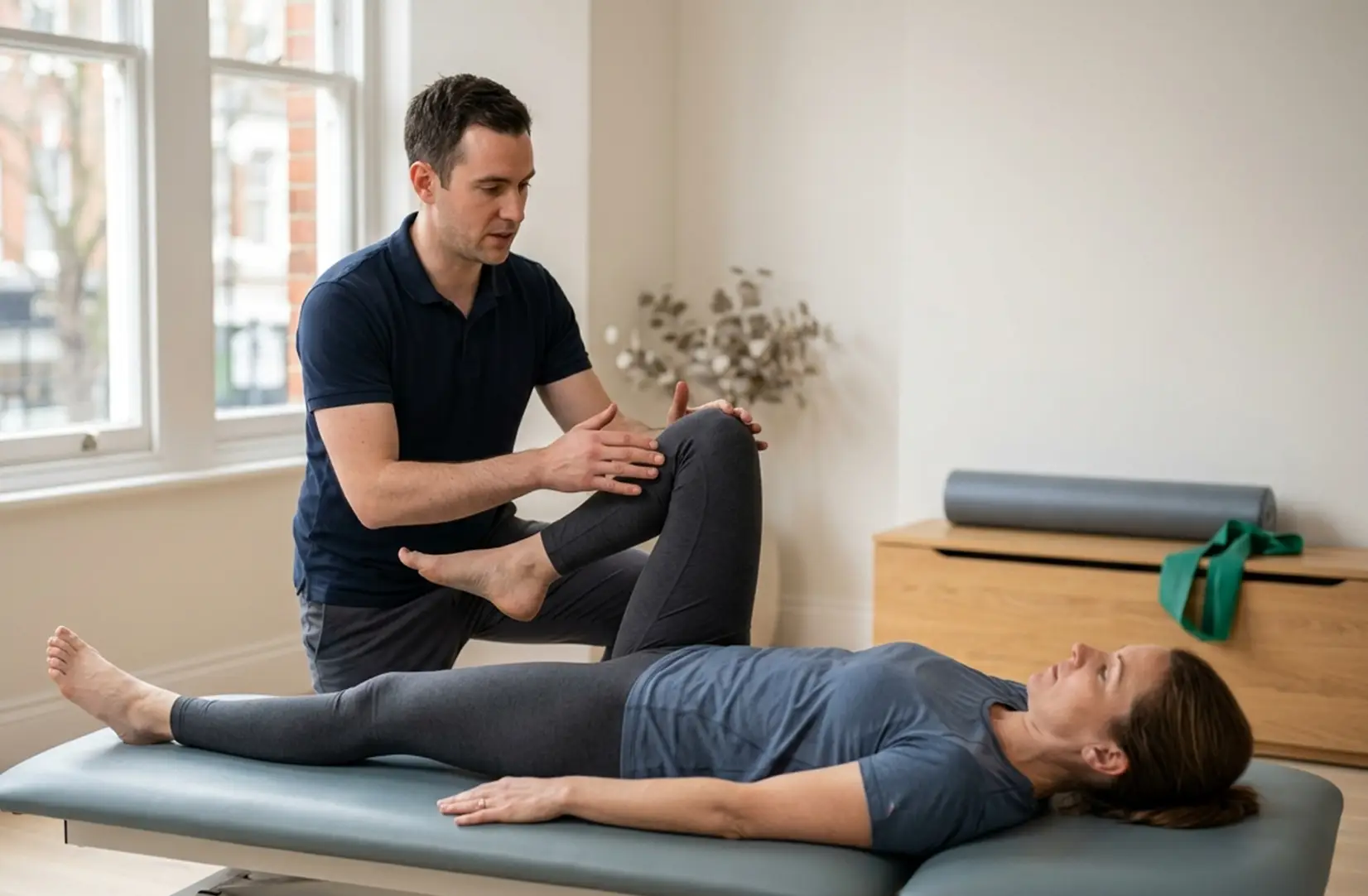
Exercises for Sciatica
If you have sciatica, you have probably already been told to do some exercises. Maybe you have tried them. Maybe they made things worse. Maybe you are not sure whether moving more will help or cause damage. That uncertainty is one of the hardest parts of living with this condition, and it is completely understandable.
This page explains how physiotherapy-led exercise prescription for sciatica actually works. Not a list of ten exercises to copy from a screen. An explanation of why the right exercises vary from person to person, how we work out which ones are right for you, and what a properly structured rehabilitation programme looks like from the beginning of recovery through to getting back to normal life.
Why Assessment Must Come Before Exercise
Many people arrive at their first appointment having spent weeks trying exercises they found online. Some of those exercises helped. Others made things worse. Occasionally, people have been doing the exact movement that was loading their disc in the wrong direction every day for months. This is not a failure of effort. It is a consequence of starting without enough information about how their body is responding.
The reason generic sciatica exercises fail so often is that sciatica is not one condition with one cause and one solution.
The nerve can be irritated by a disc pressing from behind, by a narrowing canal pressing from the sides, by the piriformis muscle compressing it lower down, or by other mechanisms entirely. The direction of movement that helps one of these presentations is often the direction that makes another one worse.
A physiotherapy assessment identifies which direction of movement reduces your symptoms. In clinical terms this is called your centralisation direction: the movement that draws pain back towards the spine and away from the leg.
Until we know this, we cannot prescribe exercises with any confidence. This is not a preliminary step before the real treatment begins. The assessment is the treatment framework.
Clinical Picture
KEY TAKEAWAY
The assessment is the treatment. Direction before intensity. Without knowing which way your symptoms centralise, no exercise prescription is more than a guess.
Extension Bias and Flexion Bias: What They Mean for Your Programme
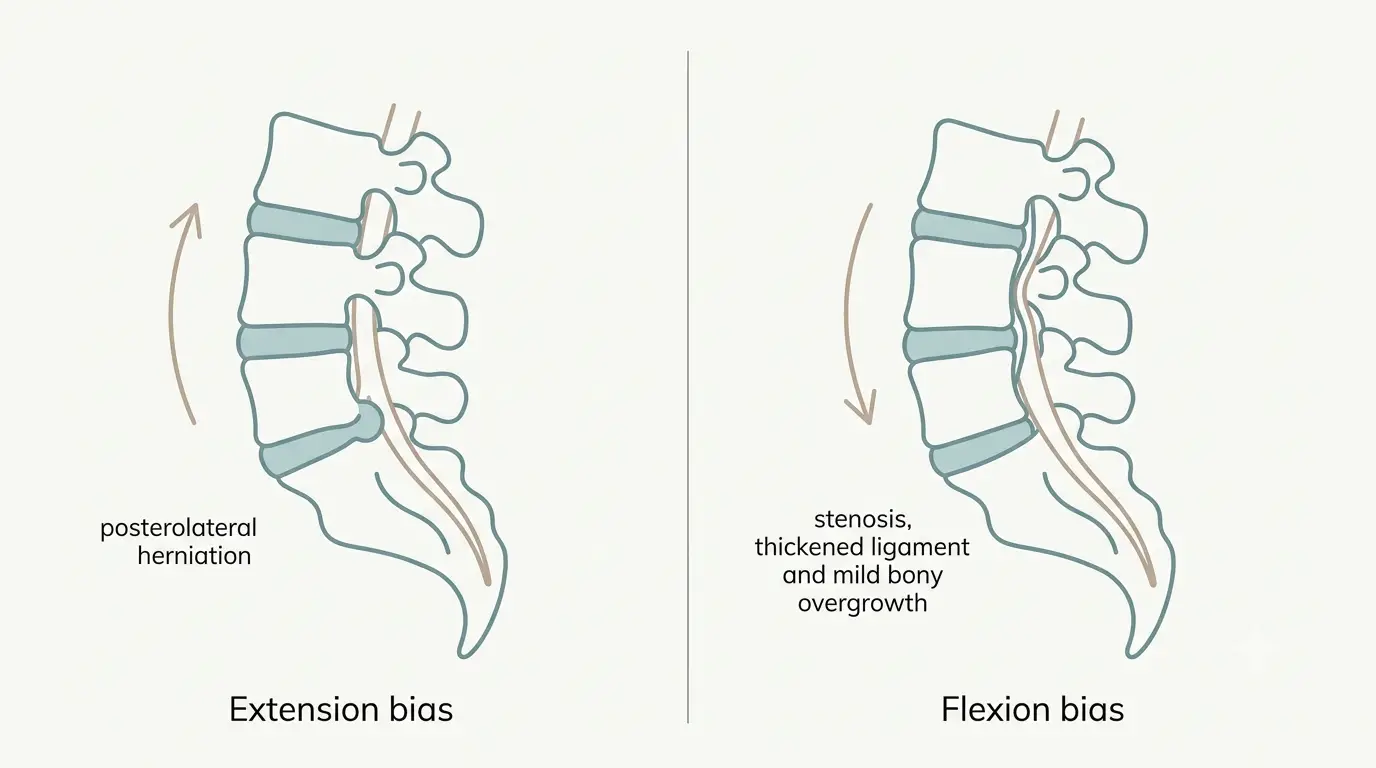
Most people with disc-related sciatica respond better to extension movements in the early stages. Extension means arching the back gently rather than bending forward. Lying face down, doing a gentle press-up from the floor, or standing with hands on the lower back and leaning carefully backwards are all extension movements. When the disc is pressing on the nerve from behind, these positions can help move the disc material away from the root and allow symptoms to settle.
A smaller group of people, often those with lumbar spinal stenosis or degenerative changes that narrow the canal, find that flexion positions give them more relief. These patients often feel better walking slightly forwards, cycling, or lying with their knees drawn up. Older adults and people with longer-standing degenerative changes are more likely to fall into this group, though assessment is still necessary to confirm it.
Neither group is doing something wrong. They simply have different anatomy and different mechanics that need different approaches.
A Note For Older Adults and People with Stenosis
If walking relieves your symptoms but you can only manage short distances before the leg aching becomes too much, this pattern - called neurogenic claudication - is typical of lumbar stenosis rather than disc herniation.
The good news is that it responds well to physiotherapy. Walking tolerance tends to improve steadily with the right programme.
A shopping trolley, slightly forward-leaning posture, or walking uphill often helps because it opens the canal slightly. Your physiotherapist will work with this pattern rather than against it.
EVIDENCE Donelson et al. (Spine, 1997) showed that the direction in which symptoms centralise during assessment is a reliable predictor of treatment response and long-term outcome. Patients whose symptoms centralised had better recovery across all outcome measures.
Not sure whether you are extension or flexion biased?
Find Out with an Assessment
Direction bias is something we identify in your first appointment. Once we know which way your symptoms centralise, your exercise programme follows directly from that. Guessing is rarely accurate and often counterproductive.
Moorgate EC2 | Strand WC2 | Chiswick W4
Neural Slider and Tensioner Exercises
When the sciatic nerve has been compressed or inflamed, it can lose mobility. Healthy nerve tissue glides freely through the surrounding structures as we move. After injury or irritation it can become tethered and sensitive. That reduced mobility is often what drives the pulling, burning sensation that runs down the leg.
Neural mobilisation exercises address this directly. There are two types, and the difference between them matters clinically.
Neural Sliders
The aim of a slider is not to stretch the nerve longer. The aim is to help it move more freely.
One end of the nerve is slackened while the other moves, creating a gentle gliding effect from the lumbar spine to the foot. Lying on your back, bring one knee towards your chest while letting the foot drop naturally. Then gently straighten the knee while pulling the foot back towards you. Slow, rhythmic, no pain. If leg symptoms increase, reduce the range rather than stopping altogether.
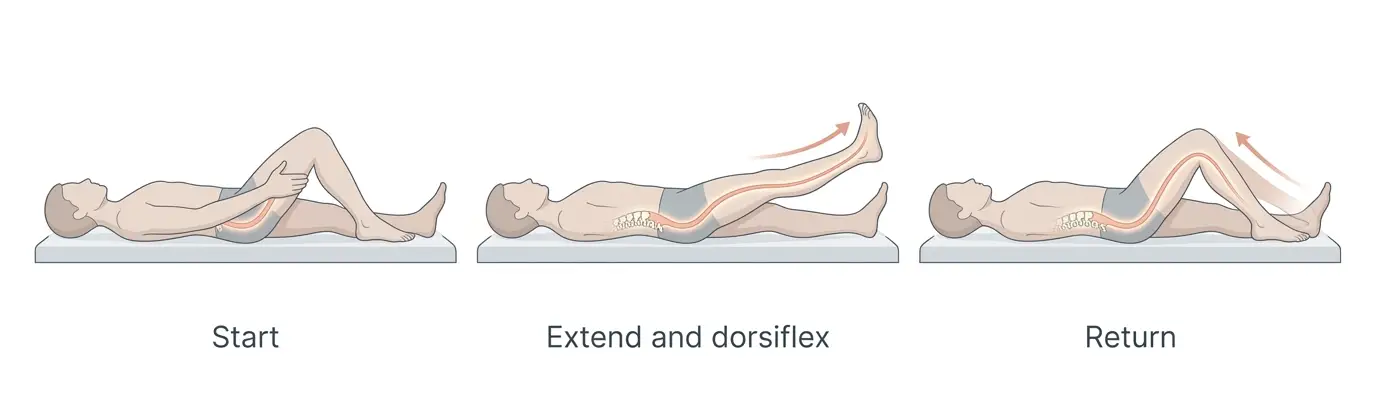
Slider technique: four things to remember
✓ Stay within a range that does not reproduce your leg pain
✓ Rhythmic and slow. This is a movement to repeat, not a stretch to hold
✓ Ten to fifteen repetitions, two or three times a day in the acute phase
✓ If symptoms travel further down the leg, reduce the range first
Neural Tensioners
A tensioner takes both ends of the nerve towards their maximum range simultaneously. More demanding than a slider. Appropriate once acute symptoms have settled. Not appropriate in the first few weeks of a flare, and should be introduced by a physiotherapist rather than self-prescribed.
If you have been told to stretch your sciatic nerve aggressively in the early days of a flare, that advice is worth questioning. A sensitised nerve does not respond well to strong tension. A slider coaxes the nerve to move. A tensioner forces it to lengthen. One tends to help at this stage. The other tends to provoke.
"I use neural sliders from the first session in most acute presentations. Patients usually notice the pulling sensation in the leg begins to ease within a few days. Tensioners come much later. Introducing them too soon is one of the more common reasons people plateau."
Dr Emma Collier PT, DPT - Moorgate EC2
KEY TAKEAWAY
Move the nerve, not the pain. Sliders mobilise the sciatic nerve gently from day one. Tensioners come later, under clinical supervision, once sensitivity has reduced.
Phase-Based Exercise Progression: A Roadmap for Recovery
Not knowing how long sciatica will last is one of the hardest parts. A clear sense of where you are in recovery, and what comes next, makes a real difference.
Recovery is not linear. Good days and bad days are both normal, especially in the first few weeks. But the overall direction, for the large majority of people, is improvement. Chiu et al. (Clinical Rehabilitation, 2015) found that disc material pressing on a nerve reabsorbs naturally in around 90 percent of cases over twelve months. The nerve settles. The pain reduces. Function returns.
What you do during that time matters. Too passive for too long slows recovery. Too much too soon provokes flares. A phase-based programme finds the path between those two. The underlying principle is simple: centralise first, then strengthen.
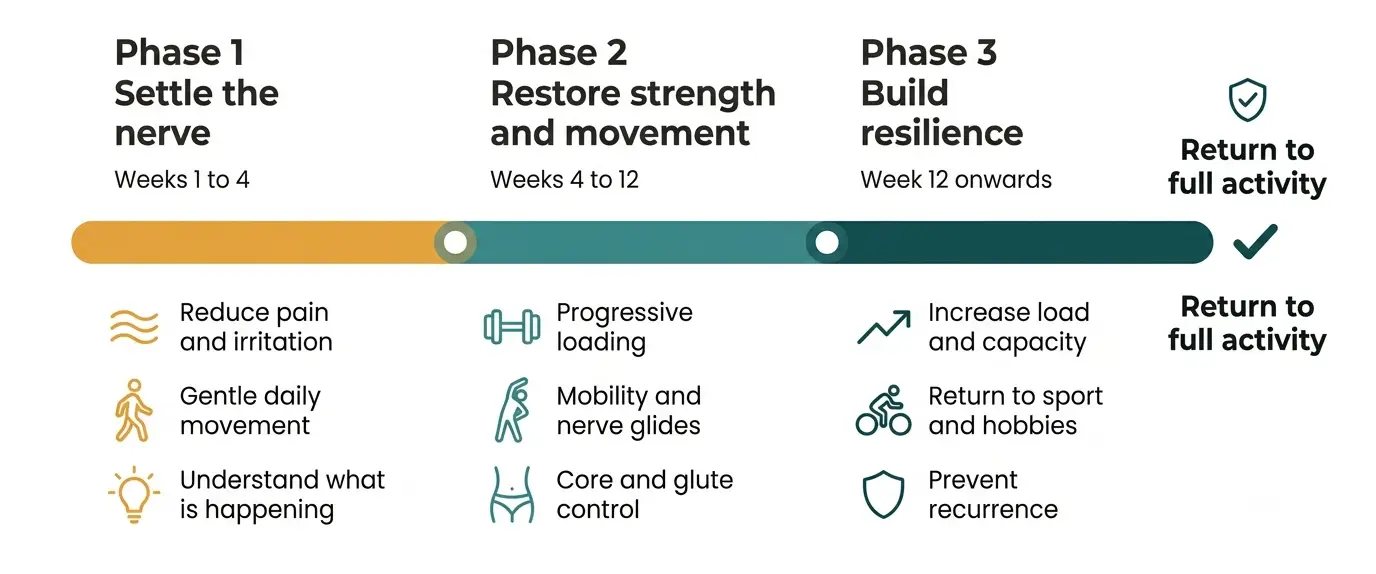
Phase 1: Acute Phase (approximately weeks 1 to 4)
✓ Find and use the positions that centralise your symptoms - this is your most important job right now
✓ Neural slider exercises within a range that does not reproduce your leg pain
✓ Gentle walking on flat ground, starting with ten to twenty minutes and building gradually
✓ Avoid sustained lumbar flexion: long periods of sitting, forward bending, hamstring stretching
✓ Avoid heavy loading of any kind
✓ Short movement sessions throughout the day work better than long sessions with prolonged rest in between
Phase 2: Subacute Phase (approximately weeks 4 to 12)
✓ Progress your direction-biased exercises, increasing range and repetitions as symptoms allow
✓ Neural tensioners can be introduced cautiously and under guidance once sensitivity has reduced
✓ Begin motor control work: dead bug, clam shell, supported bridge exercises
✓ Return to walking at a normal pace and build your distance
✓ Low-load gym work can start: range-limited leg press, seated rows, supported upper body
✓ Clinical Pilates rehabilitation is appropriate from this phase - see the section below
Phase 3: Rehabilitation and Return to Full Activity (weeks 12 and beyond)
✓ Progressive loading of the lumbar spine and lower limb in pain-free ranges
✓ Structured return to sport, running, or high-demand physical activity
✓ Functional movement patterns: squat, hinge, single-leg work
✓ Work through any fear-avoidance around movement that has built up during the acute phase
✓ Build a self-management programme you can use independently
✓ Discharge with a clear plan and criteria for coming back if you need to
EVIDENCE Fernandez et al. (BJSM, 2022) found that active rehabilitation produced better long-term outcomes than passive treatment alone. The Cochrane review by Hagen et al. (2010) confirmed that bed rest is inferior to staying active for recovery from sciatica and low back pain.
Recovery rarely looks like a smooth upward line. A bad day in week three does not mean the programme has failed. It usually means the nerve reacted to something: a long car journey, an awkward night, a stressful week. One bad day does not reset the clock. If symptoms worsen consistently over several days without an obvious trigger, that is the right moment to contact your physiotherapist.
KEY TAKEAWAY
Centralise, then strengthen. The phase-based framework follows that sequence. Each phase prepares the ground for the next one. Skipping ahead rarely saves time.
If Your Sciatica Is Related to Spinal Stenosis
Spinal stenosis is a narrowing of the spinal canal that compresses the nerve roots. It is more common in people over fifty and tends to develop gradually rather than suddenly. The leg symptoms it produces often feel different from disc-related sciatica: a heaviness or aching that builds during walking, relief when sitting or leaning forward, and a sense that you can only manage short distances before needing to stop.
This pattern is called neurogenic claudication. The exercise programme for stenosis works with canal mechanics rather than against them. Forward lean, supported sitting, and cycling positions open the canal slightly. That is the opposite of what helps most disc-related presentations, which is why assessment matters.
✓ Start with shorter walking distances than you think you need
✓ Lean slightly forward, use a walking pole or trolley if it helps
✓ Uphill tends to be better tolerated than flat
✓ When symptoms build, sit or lean forward briefly and let them settle before continuing
✓ Progress is slower than disc-related sciatica, but it accumulates reliably over weeks
Clinical picture: A 67-year-old retired teacher notices her legs ache and feel heavy after around five minutes of walking. Ten minutes sitting in a cafe clears it completely. Leaning over a shopping trolley, she can walk much further. Her programme focuses on walking tolerance in a forward-lean position, static cycling, and core work that avoids lumbar extension loading. After eight weeks her comfortable walking distance has more than doubled.
Walking distance getting shorter? Stenosis presentations often respond well to physiotherapy once the right approach is identified. We assess and treat stenosis-related sciatica at all three London clinics.
Pilates for Sciatica
Pilates has an established role in sciatica rehabilitation, but not at every stage and not in every class format. The important variables are timing, the specific movements included, and whether the instructor or physiotherapist can modify for your presentation.
In the acute phase, a standard Pilates studio class is usually not appropriate. Most classes include roll-ups, the hundred, spinal flexion sequences, and hip stretches. For someone with extension-biased sciatica, these movements will often worsen symptoms. The environment of a group class also makes meaningful modification difficult.
From Phase 2 onwards, clinical Pilates run by a physiotherapist changes things considerably. The reformer allows the spine to be offloaded while movement is built. Spring resistance supports patterns without compressive loading. Breath-integrated movement, neutral spine awareness, and segmental control work can all be developed without provoking the nerve. Dr Collier draws on her BASI Pilates training in this context specifically, building rehabilitation programmes that use the method properly rather than borrowing its language.
"The reformer is particularly useful in Phase 2 because you can get someone moving through a full range of hip and spine work with virtually no compressive load. People who have been fearful of exercise because every movement provoked their symptoms often respond well to this. They move, nothing bad happens, and their confidence in their body starts to come back. That shift is clinically significant."
Dr Emma Collier PT, DPT - Moorgate EC2
Exercises to Approach with Caution
The exercises in this table are not permanently off limits. For the right person at the right stage, most of them have a legitimate place. They appear here because they are routinely recommended online without the context that makes them safe or useful.
Direction before intensity. Phase before load. Those two principles make the difference between an exercise that helps and the same exercise that sets someone back by weeks.
How to Read Your Body During Exercise
Not all discomfort during exercise is a warning sign. Not all absence of pain means the exercise is working. Learning to distinguish between them is one of the most useful things you can do during recovery.
One rule covers most of it: watch where your leg pain goes.
If it moves towards the back and away from the foot, the exercise is almost certainly helping. If it travels further down towards the foot, it is not appropriate at this stage. That single signal, consistently tracked, tells you more than any pain score.
When Exercises Are Not Improving Things
If you have been doing exercises for three or four weeks and your symptoms are no better, this is not a sign that exercise does not work for you. It is usually a sign that the prescription needs adjusting. The direction may be wrong, the phase may be mismatched, or there may be another factor that needs addressing first. The problem is rarely effort.
There are also situations where exercise needs to sit within a broader management plan. Significant nerve compression, psychological factors like fear of movement or low mood, or a presentation that is not following the expected trajectory may all call for a different sequence.
NICE guideline NG59 recommends that people with persistent sciatica beyond twelve weeks are considered for referral that may include pain management, psychological support, or specialist investigation. Physiotherapy continues to have a role at this stage. It just works differently.
Signs that your programme may need reviewing
✓ Leg pain that consistently travels further down during or after exercise
✓ New or spreading numbness that was not present when you started
✓ No meaningful change after four weeks of consistent exercise
✓ Increasing fear of movement or growing avoidance of activities
✓ Any bladder, bowel or bilateral leg weakness changes: contact your physiotherapist immediately or go to A&E
If exercises keep flaring your leg pain, the problem is often the prescription — not your effort.
Let Us Review Your Programme
A single assessment appointment is usually enough to identify what needs adjusting. The direction may be wrong, the phase may be mismatched, or the load may need scaling back. Most plateaus in sciatica recovery are reversible once the prescription is corrected.
Moorgate EC2 | Strand WC2 | Chiswick W4
Self-Management at Discharge
The goal of rehabilitation is not dependence on a physiotherapist. It is building the knowledge and tools to manage your own back and nerve health over time.
A good discharge point is when you understand what your body needs, you know what to do if symptoms flare, and you are confident enough in your recovery to get on with your life. That confidence is not a bonus. It is part of the treatment.
A discharge programme from Atherapy typically includes a maintenance exercise set of around ten to fifteen minutes, three or four days a week. It also includes a clear flare protocol: what to return to if symptoms come back, for how long, and when it makes sense to book in again rather than self-manage.
Recurrence is common in disc-related sciatica. But the severity and duration of recurrences tend to reduce over time as people understand their condition better. Knowing that a bad week is manageable rather than a crisis changes the experience of it entirely.
What a discharge self-management programme includes
✓ Maintenance exercise set: direction-biased and neural mobility work, progressed to full independence
✓ Core and lower limb strength programme, matched to your activity level and goals
✓ Flare protocol: a clear step-down plan if symptoms return, without needing an urgent appointment
✓ Activity and posture guidance: sitting tolerance, sleeping position, return to exercise milestones
✓ Criteria for re-referral: what counts as a reason to come back
EVIDENCE Vlaeyen and Linton (Pain, 2000) and Pinheiro et al. (Pain, 2016) both identified fear-avoidance beliefs as significant predictors of poor outcome in back-related conditions. A confident self-management framework reduces catastrophising and supports long-term recovery.
Key Evidence
The following references inform the clinical content onthis page:
- Browder DA, Childs JD, Cleland JA, Fritz JM. Effectivenessof an extension-oriented treatment approach in a subgroup of subjects with lowback pain. Physical Therapy. 2007;87(12):1608-1618.
- Donelson R, Aprill C, Medcalf R, Grant W. A prospectivestudy of centralization of lumbar and referred pain: a predictor of symptomaticdiscs and anular competence. Spine. 1997;22(10):1115-1122.
- Chiu CC, Chuang TY, Chang KH, Wu CH, Lin PW, Hsu WY. Theprobability of spontaneous regression of lumbar disc herniation. ClinicalRehabilitation. 2015;29(6):525-533.
- Hagen KB, Jamtvedt G, Hilde G, Winnem MF. The updatedCochrane review of bed rest for low back pain and sciatica. Spine.2010;30(5):542-546.
- Fernandez M, Ferreira ML, Refshauge KM, et al. Activeversus passive approaches in the management of acute low back pain. BritishJournal of Sports Medicine. 2022.
- Vlaeyen JWS, Linton SJ. Fear-avoidance and itsconsequences in chronic musculoskeletal pain: a state of the art. Pain.2000;85(3):317-332.
- Pinheiro MB, Ferreira ML, Refshauge K, et al. Symptoms ofdepression and risk of new episodes of low back pain. Pain. 2016.
- Peul WC, van Houwelingen HC, van den Hout WB, et al.Surgery versus prolonged conservative treatment for sciatica. New EnglandJournal of Medicine. 2007;356(22):2245-2256.
- NICE guideline NG59: Low back pain and sciatica in over16s. National Institute for Health and Care Excellence. 2016 (updated 2020).
- Liddle SD, Pennick V. Interventions for preventing andtreating low back and pelvic pain during pregnancy. Cochrane Database ofSystematic Reviews. 2015.
London Physiotherapy Team
Welcome to the Atherapy expert clinical team. We are a dedicated group of qualified physiotherapists and sports medicine specialists committed to delivering innovative, evidence-based rehabilitation. Our practice is built on a holistic approach to physical health, firmly believing that injury prevention is just as vital as the cure. From treating acute sports injuries to designing custom performance optimization programs, our clinicians work collaboratively to help you safely reach your goals.
Meet our resident experts below and find the right specialist for your recovery journey.

- With 25+ years of Premier League and Championship experience, Andrew has led Medical, Science, and Performance departments for Hull City, Nottingham Forest, Derby County, and Preston North End, following earlier work at the Manchester United Academy
- Specialist in lower limb rehabilitation
- Post-operative rehabilitation
- Back pain and complex spinal presentations
- Elite athlete management including manual therapy, gym rehabilitation and acupuncture
- Specialises in complex cases and second opinion rehabilitation planning including return to play
- Limited clinical availability due to wider clinical leadership and operational responsibilities
Andrew Balderston
Based at Moorgate

- Specialist in exercise-based rehabilitation, manual therapy and injury prevention
- Experienced in post-operative rehabilitation and progressive return to activity
- Clinical interests include sports injuries, cervical spine and low back dysfunction, shoulder, knee, foot and ankle rehabilitation
- Combines hands-on treatment with targeted strength and rehabilitation programming
- Focused on structured rehabilitation to help patients rebuild strength, movement confidence and function
- Specialist interest in women’s health support including manual lymphatic drainage during pregnancy and pre/post-natal care
- Over 15 years of clinical experience across private practice, sports rehabilitation and women’s health settings
- Fluent in English, Portuguese and Italian
Fernanda Saldanha
Based at Chiswick

- Extensive experience working within elite professional football and private practice
- Former Tottenham Hotspur Academy physiotherapist specialising in performance rehabilitation and return-to-play management
- Specialist interest in post-operative rehabilitation and upper and lower limb injury management
- Experienced in managing complex and recurrent injuries through structured, evidence-based rehabilitation planning
- Clinical approach combines manual therapy, gym-based rehabilitation, movement analysis and acupuncture
- Focused on restoring movement quality, strength under load and long-term performance outcomes
- Fluent in English and Greek
Dimitrios Michtatidis
Based at Chiswick and Strand

- Level 4 Strength & Conditioning Coach
- Medical Acupuncture & Dry Needling Qualified
- Combines detailed clinical assessment with progressive rehabilitation and strength & conditioning principles
- Specialist interest in gym-based rehabilitation and return-to-sport management
- Clinical interests include acute sporting injuries, post-operative orthopaedic rehabilitation (including ligament reconstructions, meniscal and labral repairs) and hip/groin pain in active populations
- Experience managing both active general population and performance-focused clients
- Adjunct treatment techniques include dry needling and shockwave therapy
Claire Cuffe
Based at Moorgate and Strand

- Over 5 years experience treating orthopaedic injuries, chronic pain and post operative care
- Advanced certifications in dry needling for hands, face, feet, lower limb, upper limb and lumbopelvic region
- Certified pelvic floor physio for both men and women with an interest in treating clients pre and post natal
- Special interest in strength and conditioning programming for clients training for half/full marathons