

The Telegraph has been looking into a question that has quietly become one of the more interesting problems in performance medicine: how are so many musicians still playing full stadium shows in their eighties, and what is actually keeping them there?
For the answer, the paper went to Dave Hancock, our founder.
Why They Called Dave
Dave has spent more than three decades keeping people on the pitch, on the court and on the stage, usually when the schedule offers no room to be unavailable.
He was head physiotherapist at Leeds United and then at Chelsea, where he was part of the 2007 Premier League and cup-winning setup and the run to the 2008 Champions League final. He spent five years with the England senior men's national team, including the 2010 World Cup and Euro 2012. In 2008 he became the first British physio to be recruited full-time by an NBA franchise, joining the New York Knicks as Performance Director with responsibility for the medical, strength and conditioning and sports science operation.
He holds two Master's degrees, in Sports Exercise Medicine and Manipulation, is a certified trainer and strength coach in both the UK and the US, sits on Nike's Performance Board and has published widely on ACL rehabilitation. He founded Atherapy in 1997, and he is also chief executive of Apollo, the athlete management platform used by elite clubs and franchises.
Alongside the sport, he has toured with U2 and Madonna. That combination is rare, and it is the reason the Telegraph piece has something new in it. Very few people have run the medical side of a Premier League season, an NBA season and a world tour, and can therefore say with any authority how the three compare.
What The Article Says
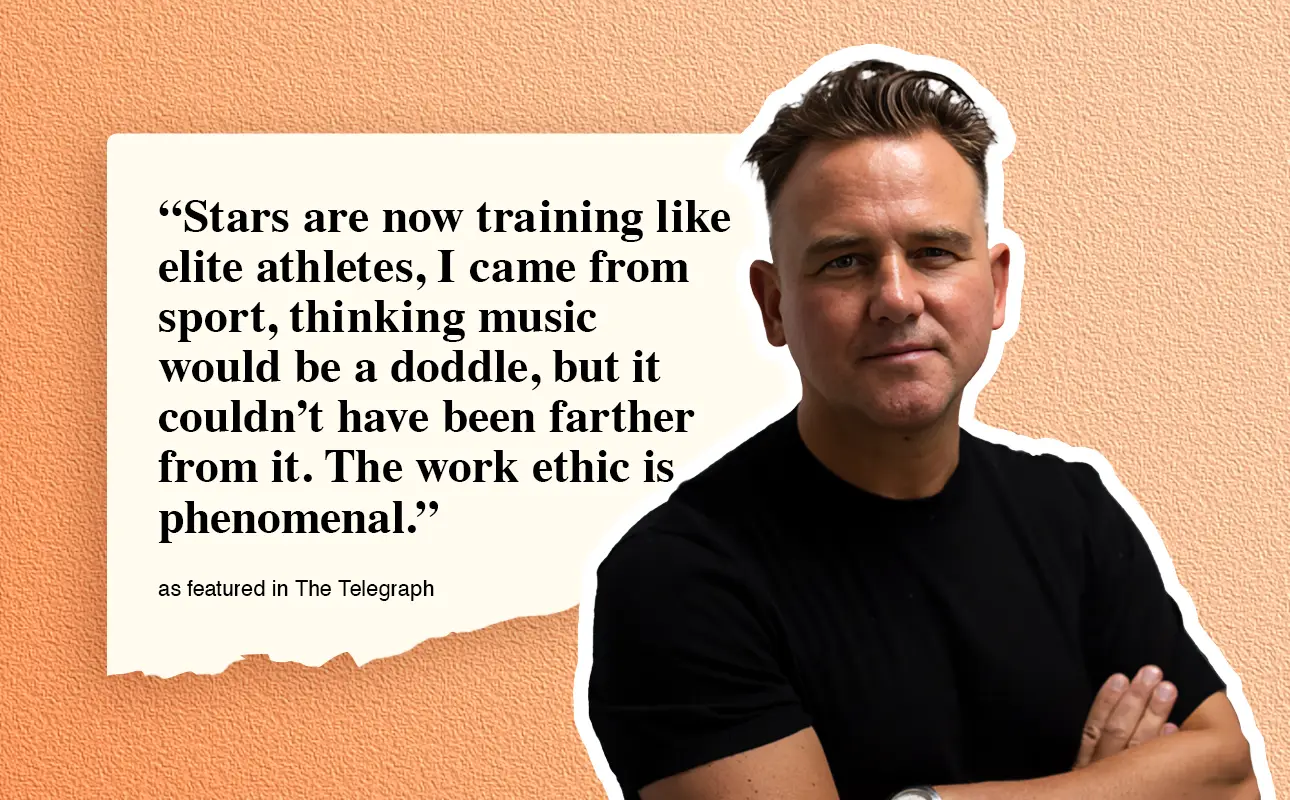
Dave's central point is that the mythology no longer matches the reality. The touring performers still working at this level are, in his words, "training like elite athletes", and he says the work ethic surprised him even coming from professional football, where he had assumed music would be the easier assignment.
The piece describes what that looks like in practice. Older performers do short, hard bursts of indoor cycling specifically to support lung capacity and breath control while singing. On-stage energy expenditure gets tracked so that the tour chef can match protein intake to it. The post-show routine has replaced the night out entirely: legs into ice-compression on the drive back to the hotel, then an hour of recovery work at one in the morning while the artist listens back to the performance for mistakes. Dave keeps a bed backstage so he can work on people during breaks in the set.
It also covers the less sober end of the market, and Dave is notably unimpressed by parts of it. Dressing rooms now contain cryotherapy chambers, steam chambers and IV drips. Some performers use peptides, which are not FDA-approved for these purposes. Some inject stem cells into arthritic knees and shoulders. Dave's view is that the science is not there yet on much of it, however enthusiastically the industry has adopted it.
Asked whether the wellness arms race will keep pushing headliner ages up, he says it will, comfortably into the eighties. Past ninety, he thinks the physical demands of touring make it unlikely regardless of what medicine does next.
The full feature, which also covers Rod Stewart, the Stones, the Who and Iggy Pop, is worth reading in full.
Read the full story in The Telegraph
What This Means If You Are Not On A World Tour
The reason we are proud of the piece is not the celebrity names in it. It is that the approach Dave describes is the same one running through every Atherapy clinic.
Nothing in that touring routine is exotic. It is capacity built and maintained over years rather than crammed before a deadline. It is training aimed precisely at the demand, which is why the cycling intervals exist to serve breath control rather than because cardio is generally good for you. It is recovery treated as scheduled work rather than something you hope happens overnight. And it is somebody competent paying attention all year round and changing the plan when the body changes.
Apply that to a 68-year-old who wants to keep playing tennis on a Tuesday, or someone twelve weeks out from a knee replacement, and the principles do not change. Only the numbers do.
The corollary is Dave's scepticism, which matters just as much. The interventions with the strongest evidence behind them are progressive strength work, sleep, sensible nutrition and honest load management. They are also the least marketable, which is precisely why so much money flows toward the alternatives. If a treatment is being sold to you mainly on how advanced it sounds, ask what the evidence actually shows.
Atherapy has been treating professional athletes, performers and the public to the same standard since 1997. If you want an assessment that starts with what you actually need to be able to do, book with your nearest clinic.